Sunday, December 5, 2010

Christmastime in Canal City

Canal City Hakata is probably Fukuoka's most famous mall: it's a big, labyrinthine construction with outdoor promenades and a big spherical performance space that looks like something out of Dr. Robotnik's lab. We wrote about the place in a post back in August.

For various reasons (which include a sweater vest and a co-worker who plays piano in the Hyatt on the weekends), we've been down to Canal City a few times the last couple weeks. They've really decked the place out for the Christmas season, which is purely a commercial holiday here in Japan (any excuse to shop), in stark contrast to the almost entirely religious celebration we saw in Korea.

Anyway, here are some shots from a very festive Canal City.

Nana eats a hard-earned brownie & ice cream crepe in front of . . . I don't know, some kind of snow palace bridge maze? (Did I mention that Canal City has an ornamental canal running through it?)
Cleaning up after glitter rained down on the Dr. Robotnik stage.
At regular intervals, this pool of water erupts into a fountain show synchronized to holiday music. "Sleigh Ride" seems to be a favorite here: we hear it EVERYWHERE.
We never did figure out what was in this strange mushroom hut, which was also suspended over the water.
A video of an odd little musical display set up at one of the two minor stages at either end of the mall:

In related news, we're into the final push before Christmas break (!), so don't be surprised if you don't hear much from us this week.

Sunday, November 28, 2010

Sumo Sugoi

(Sugoi is the Japanese word for "Wow!" I will conquer this language, one semi-useful word every few weeks!)

Sumo is probably one of the first things that comes to mind for a Westerner thinking about Japan, but all I really knew about it was that the men were really large, and that Freakonomics had a chapter about sumo match-fixing. So when we had the chance to attend a honbasho, or major sumo tournament, right here in Fukuoka, we went to become culturally enlightened. I didn't expect that I would really like it -but I actually had a great time. Sumo is a lot of fun!

First, some background. In sumo, wrestlers move up in rank based on their performance in major tournaments, of which their are six per year. Three happen in Tokyo, one in Osaka, one in Nagoya, and one here in Fukuoka. The ultimate goal of every sumo wrestler, or rikishi, is to be granted the title of yokozuna ("horizontal rope," from the rank belt a yokozuna can wear), and the minimum requirement is generally to win two of these tournaments in a row.

Some things about yokozuna I did not know:

-there can be an unlimited number at any given time (right now there is just one, the Mongolian Hakuho) and there can even be no yokozuna at all
- there have been four foreign yokozuna: two Americans (Akebono, from Hawaii, and Makuuchi, from American Samoa), and two Mongolians, Asashoryu and Hakuho.
- yokozuna is a title for life, and cannot be lost. The yokozuna is expected to retire when he can no longer compete at a top level.
- yokozuna do not have to be that huge: the man we saw, Hakuho, is 6'4 and 340, which means you have at least four guys his size or bigger on a D-1 offensive line. Akebono, however, wrestled at 6'8 and 517. Good NIGHT, that's a large man. And there are no weight classes, so any rikishi might find himself faced with a man that size at any point.

We sat in the nosebleed section, which nevertheless costs over $30 a ticket. And, ironically for a sport involving men the size of Akebono, the chairs are so tiny that Justin and I could not fit side-by-side without one of us sitting forward or putting an arm around the other.

These flat seating areas are much more comfortable, but at the starting price of 9,200 yen, or over a hundred bucks at these exchange rates, I will go with the tiny chairs. The fact that so many are empty doesn't really mean much: a tournament begins fairly early in the day (maybe 9 or so; I don't remember) and goes until 6 PM. So these fans might have been and gone by the time we got there around 4:30.

This picture shows the wrestling area:

The sandy-colored area, made of clay, is called the dohyo. There is a raised ring on the clay, which represents the "in" area. A rikishi wrestler has to either shove the other guy out of the ring or cause any part of his opponent's body other than the feet to touch the ground.

Above the dohyo is a roof to represent a Shinto shrine (the sumo salt-throwing that happens before matches is a Shinto purification ritual). The tassels represent the four seasons, and the dohjo is oriented east-west, with those serving as the sumo equivalents of "the blue corner" (i.e. "Wrestling as the east yokozuna - Hakuho!")

And the equivalent of the ring girls: sponsor banner boys.

And now what you've been waiting for... actual wrestling!

Matches don't have to start right away. The wrestlers line up on and try to intimidate each other, and then break apart and walk around for a bit. There used to be no time limit on how long they could go before starting the match, but now they have a three-minute play clock. This can seem a bit dull, but you have to think of it the way you think of the time in football before the ball is snapped: it's time for strategy, time for giving signals to your opponent and trying to out-think the signals he's giving you back, and time to build dramatic tension for the audience. And since I'm constantly annoyed by people who say football is boring because of the time when "nothing happens," just because they can't perceive the things that are happening, I am trying to reserve judgment on sumo pauses until I can learn to appreciate them.

Matches, like downs, go quickly:


Now, how cool is that?

The last match of the day was between the yokozuna Hakuho and the ozeki, or second-rank, rikishi Kaio (the wrestling names, by the way, are noms de sumo, and not the real birth names of the rikishi). My shoddy Japanese was just good enough for me to catch the word Fukuoka and deduce from the cheering that Kaio is a local boy - which Wikipedia confirms. He's apparently had a rough few last tournaments, and has been an ozeki longer than all but one other wrestler without retiring or being promoted to yokozuna. He was tied with Hakuho at 11-1 (a tournament is fifteen matches) on the day we were there, so that was a big-deal fight. The crowd was firmly on his side - as a sentimental favorite, hometown boy, and possibly also because he's the only Japanese ozeki at the moment so he might represent the only national hope for a Japanese yokozuna. (the other three are Mongolian, Bulgarian, and Estonian - the Estonian, Baruto, was also very popular at this honbasho.) Much clapping and cheers of "Ganbatte (Let's go!) Kaio!" ensued. Unfortunately for Kaio, he lost a hard-fought match, which lasted a surprisingly long time.

According to Wikipedia, Hakuho ultimately won the tournament with a record of 14-1, his fifth honbasho tournament victory in a row, and Kaio finished at 12-3.

I had a great time despite the tiny chairs. I hope there's more sumo in my future!

Thanksgiving Dinner

To help us homesick expats celebrate the holiday in style, the FIS school culture committee organized a special Thanksgiving dinner at the Hilton. Nana and I weren't really sure what we'd be eating, but we had our hopes up for some traditional Thanksgiving fare.

And we weren't disappointed! We had a private room at the Hilton buffet stocked with turkey, stuffing, potatoes, pumpkin soup, and cranberry sauce.
The only thing missing was a good old-fashioned pumpkin pie: we had to settle for an odd pumpkin tart and some pumpkin pudding.
In addition to our private buffet, we also had free range over the main buffet, which included mostly Japanese or pan-Asian dishes, as well as enormous piles of crab legs.
It took a little bit of work to get that melted butter (in Japan, they serve crab legs with ponzu sauce), but according to Nana the result was well worth it. I, in the meantime, spent most of my stomach capacity on the old-fashioned Thanksgiving fare, which was delicious (but, it must be said, not quite like Grandma used to make), and on red meat, which can be hard to come by in this town.

Edited to add: Go team Crab!

Thursday, November 25, 2010

Happy Thanksgiving from the Senseitions!

Celebrated Thanksgiving in style tonight: at best of the local Indian restaurants, with a handful of co-workers. (Alas, my crummy cell-phone photo didn't work out.) Then on Saturday we have a Thanksgiving dinner at the Hilton. Still not sure what's on the menu, though I will say I would kill for some turkey and some pumpkin pie right about now.

Anyway, if we can't be home for Thanksgiving, I guess this is the next best thing. It's certainly hard to be away from home again for what might just be my favorite holiday . . . but our FIS buddies do help make this place feel a little more like home!

All our love to you readers out there--here's hoping you have a great holiday.

Wednesday, November 24, 2010

Fall Foliage and a Giant Buddha

Thanks to yet another mid-week Japanese holiday, Nana and I just dozed our way through a much-needed four-day weekend. But we didn't spend the whole weekend catching up on work and sleep: instead, on Sunday morning, we joined a few co-workers for a half-day trip to Kidonanzoinmae, a little hamlet up in the hills famous for its huge reclining Buddha.


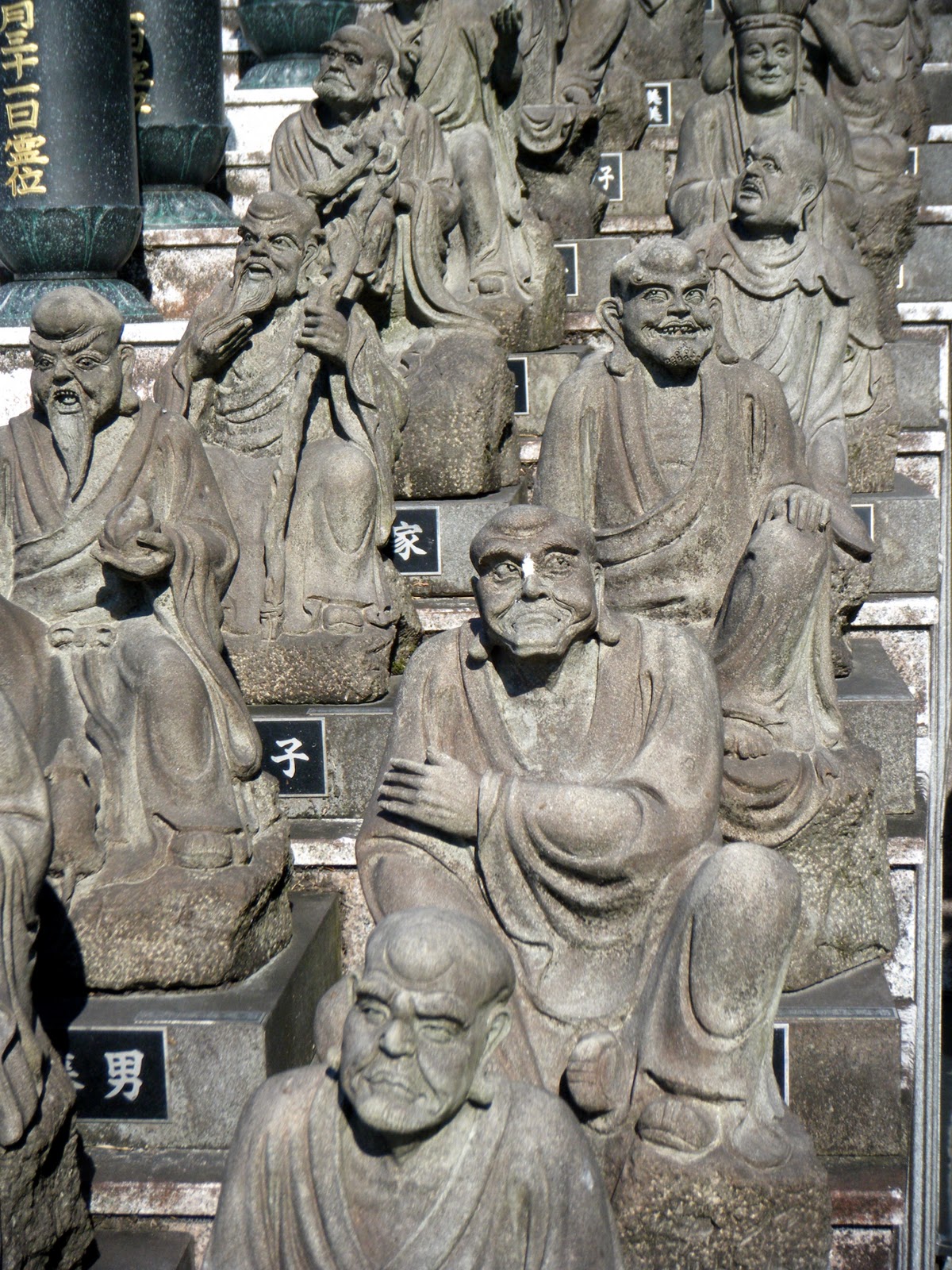
The Buddha was surrounded by little statues, each with a different posture and facial expression . . .
. . . as well as what appear to be urns, each marked with a day of the year.
I wish I could tell you more about the ritual significance of these things, but most of the tourist information at Nanzoin was in Japanese. Though running the temple's website through Google Translate does reveal at least a little bit about the site: the statue was built in honor of some sacred relics the temple received as gifts from Buddhist communities in Nepal and Burma.

Luckily, although there was little English to be found, the gentlemen below were well versed in the universal language of expats abroad, aka Repeated Emphatic Gesturing, and were able to explain to us (and co-worker/neighbor Dayle) how to say a Buddhist prayer.
Nana lights a votive candle.
Nana sticks some incense (joss sticks) in a vessel full of sand.
Apparently, the key ingredients in Buddhist prayers are candle-wax burns and second-hand incense smoke.

The Buddha wasn't the town's only attraction, though: it's just part of a complex of temples and shrines strewn across a mountainside--and connected by a network of trails and caves. There wasn't really any signage in English, so I can't really do anything but let the pictures speak for themselves. Enjoy!


 This tunnel was full of incense smoke from a small shrine cut into the wall.
 Most of the hillside was covered with sugi, or Japanese cedar, the national tree of Japan.
The Japanese really have a thing for turtles. You can find a turtle pond in almost any Japanese temple.
 We weren't sure if this guy was real at first. He was really still, and his legs were sticking our at such an unnatural angle. (Yes, the big one is fake.)
 Fall colors on the hillside.
 Looks like they dress some of their statues up for the winter.
 Part of the temple complex was a kind of elaborate garden built on the hillside, with streams and waterfalls and bridges. It was almost like a temple playground--very beautiful, and lots of fun to explore.
This is what a Japanese-style temple looks like when it's new. Eventually, that fresh wood will weather to a grayish brown.
 This guy seems to be on fire for some reason.
Many of the little statues had these donation buckets in front of them. Anyone have any idea what they're for?
 More statues bundled up for the winter.
 This little shrine was tucked away in a little grotto at the top of the complex. That's a waterfall in the background, and there's a very small cave to the left you can walk through, with a chain to help you climb out the top.
 A shot of the shrine complex.
 On our way out, Nana rubs Buddha's belly for good luck. You can see he's worn a little thin there.
 One of the entrances to the temple/shrine complex. That's a gingko tree--I love the brilliant shade of yellow they turn in the fall.

Tuesday, November 23, 2010

Crisis in Korea

Don't know what kind of airtime this is getting in the American media, but the top story on BBC News Asia is about an artillery battle along the hotly contest Western sea border between North and South Korea. Apparently, North Korean artillery opened fire on military and civilian targets on Yeonpyeong Island.

Scary. This is certainly the worst it's been since we've been in Asia. As Nana says, in light of the recent Cheonan incident, in which North Korea got away scot-free with an unprovoked attack on a South Korean military ship, it seems like the North has decided it can kill South Koreans with impunity. This is kind of how it was in as late as the 1980s, when frequent North Korean terrorist attacks claimed dozens to hundreds of South Korean lives every year.

But who knows if the South and its allies will take action. With North Korean artillery trained on Seoul and South Korean and American aircraft trained on Pyeongyang, the two sides are locked in a kind of non-nuclear mutually assured destruction. A Mexican standoff, if you will.

For the sake of all our friends in Korea, though, let's hope this one gets resolved as quickly and peacefully as possible.

Justin and Nana Eat Weird Stuff for Your Entertainment: Fried, Sugar-Coated Sweet Potato

The place we bought these was basically a shack with a deep fryer next to a tiny little train station up in the hills.
They also sold fried chicken and fried . . . I don't know? Fish cakes? But we opted for these huge chunks of sweet potato.
Verdict? Awesome! (They also get the co-worker/neighbor Dayle seal of approval.)

More on our excursion to the nearby temple/shrine complex later.