Sunday, September 25, 2011

Yakitori - Grilled Meat on a Stick

There is simply nothing wrong with yakitori. Like many things Japanese, the concept is simplicity itself, executed to perfection: get high-quality ingredients, put them on a stick, and grill them over open coals. Yakitori is usually grilled with salt or with a mild, vinegary basting sauce somewhere between soy sauce and teriyaki. Technically, the word "yakitori" refers to chicken, but it's usage also covers a variety of meats and sometimes vegetables.

You can find yakitori places all over Japan - the smoke billowing out into the street is usually the first clue - but the town of Kurume here in Fukuoka prefecture is especially famous for its yakitori. They host a big festival every year that's part of their claim to fame. Nana and I missed the festivities last year, but this year we gathered a group of coworkers and headed down for the day.

Like any other late-summer day in Kyushu, it was hot and humid with a pretty good chance of some rain. We got to the festival just in time for lunch, after a train ride from Tenjin and a short walk down one of Japan's ubiquitous shopping arcades (shotengai).

A dense cloud of aromatic smoke hung over the square - so dense it made our eyes smart, in addition to our bellies.

Long lines of people snaked towards the different booths, each of which, like nearly any Japanese eatery, offered its own slight variation on the classic dish.

In each booth, piles of meat were stacked high on metal platters, ready for the grill. The cooks worked feverishly, trying their best to keep the lines short without sacrificing quality.

Of course, this being Japan, quality won out, and a few of the lines stretched out to twenty or thirty minutes long. After a quick appraisal of the situation, we adopted a divide-and-conquer strategy and settled in for what promised to be a long and tantalizing campaign.

Still, good food and good company kept spirits high.
Pictured: elan.
Our first siege was brutal (you try smelling grilled meat for thirty minutes on an empty stomach), but we ultimately emerged victorious. And the spoils of victory, it turns out, were well worth the wait.

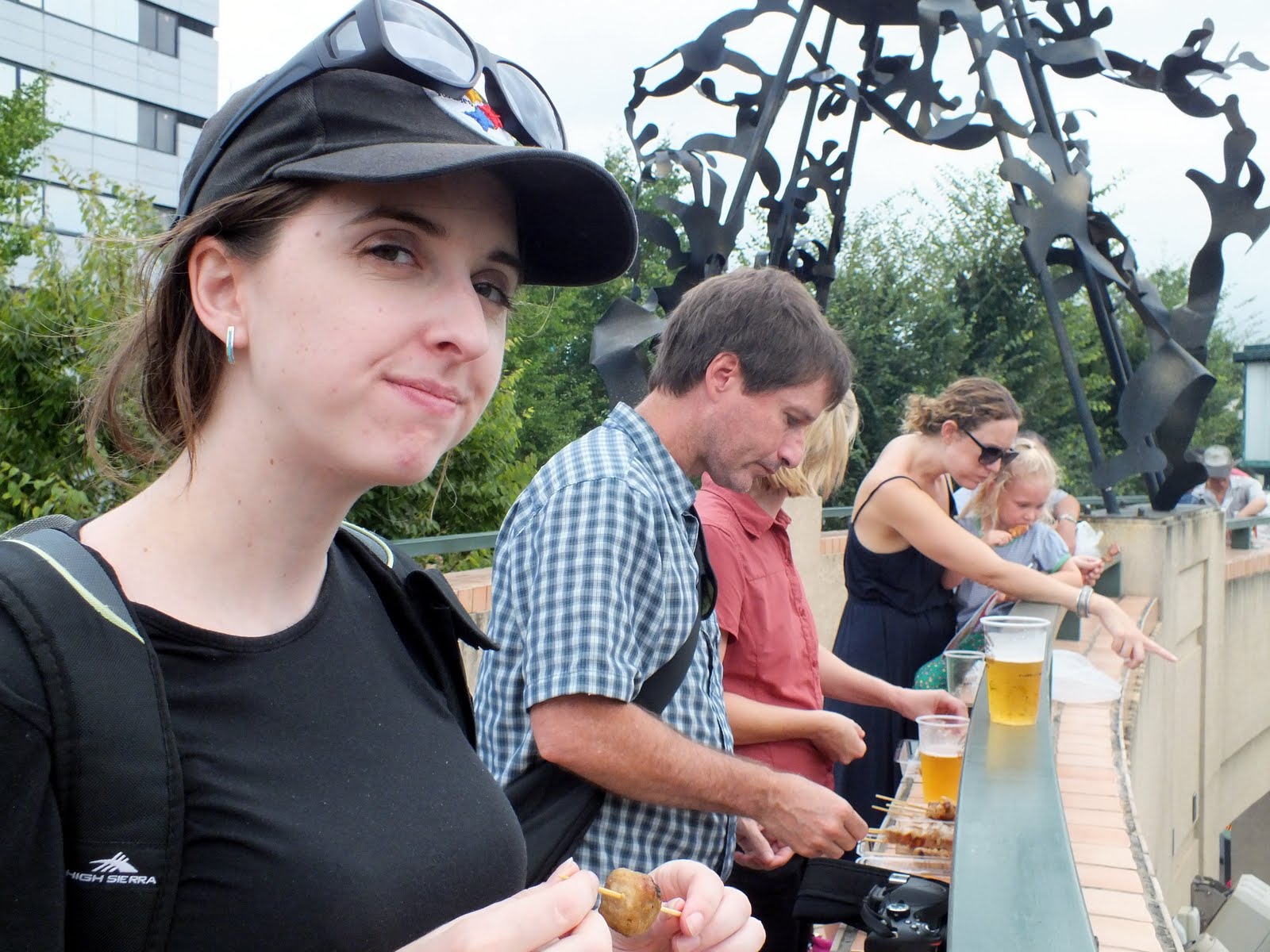
Seriously, how many photos do we have of Nana eating?
Almost as many as we have of Nana looking satisfied after taking a bite.
Fortified by this victory, we found our subsequent foes much easier to defeat.

By the final reckoning, we had eaten over a dozen skewers each - in addition to various bits of chicken and pork, we also indulged in some Korean-style marinated beef and Nana's beloved chicken meatballs (tsukune), with a tebasaki (grilled salty chicken wing) taking the place of desert.

Cold beer and grilled meat on a hot summer's day? For an American, I'm not sure life gets any better than that.

Friday, September 23, 2011

SAT update

I mentioned in the previous post that I was emailing the SAT folks to find out how to do training when it's only offered in the middle of the night. I sent one set of emails in reply to a master email chain (one of those generic "Testers@whatever" emails) and then realized that earlier I'd heard from a human being, so I maybe should write them back because it could be quicker.

This morning, I received two emails with a training presentation attachment. The two emails read:

1. "I have emailed the presentation to you an [sic] closed your center as having completed the training. Thank you!"

2. " Please review the presentation. You are not considered as having completed the training. Thank you!"

I AM SCHROEDINGER'S QUANTUM SAT PROCTOR!

Wednesday, September 21, 2011

Things We Have Been Doing Instead of Blogging

We have neglected the blog for a while. This puts the blog in excellent company, along with such elements of life as sleep, nutrition, and personal hygiene (I've been meaning to repaint my toenails for about three weeks now). The laundry is unfolded. The G12 research papers are ungraded. So what on earth has gotten done around here in approximately the last week?

We spent

2 - Days in Nagasaki, in which we visited
4 - Museums, including the Atomic Bomb Museum, the former Dutch settlement at Dejima Island, the small and random Siebold Museum, and the Nagasaki History and Culture Museum, at which
1 - Museum t-shirt was purchased, size Medium (slightly too big, which is bizarre in Japan) as well as
4 - books for the FIS library on Japanese history, which of course required filling out
1 - reimbursement request form stapled to
3 - receipts

Speaking of travel:

60,000 - yen, from the wonderful PTA, allocated into scholarships for the SEOMUN Model United Nations conference, disbursed to
2 - deserving applicants on the basis of essays read by a parent and yours truly, on the basis of
2 - letters to parents and application forms written by yours truly, followed by
1 - letter about payment and passport deadlines, written by yours truly, supplemented by
11 - airplane seats booked to Seoul, but not this time by me.

What else?
1 - College reference request form for students designed, cleared with fellow faculty, and disseminated
3 - emails sent to College Board to find out how I can train as an SAT proctor when training takes place at 3 AM Japan Time
0 - answers from College Board
14 - Japanese university English-language programs catalogued into a heiny-kicking spreadsheet with course descriptions and application deadlines
4 (more?) - emails to students and parents advancing the college application process for their children

And let's not forget:
3 - meetings with individual students to sort out applications
5 - faculty meetings about internal school policy to schedule a meeting with
11/12 - grade parents next Tuesday after
55 - minutes of elementary school martial arts, which I help coach from 3:35-4:30, but I can't attend on Thursdays, because of
75 - minutes of Japanese class, which meets after
20 - minutes of subway ride downtown

Finally
4 - sanity-saving romance novels desperately read while in epic denial of my upcoming to-do lists
2 - happy birthday phone calls to official Blog Moms, who were courteous enough to be born on the same day and keep things easy for me and Justin
1 - hat blown off upriver in today's typhoon

Which was really just insulting.

Thursday, September 15, 2011

Nihongo o sukoshi hanashimasu!

(Translation: "I speak a little Japanese.")

For me and Nana both, one of our greatest regrets about the time we spent in Korea (besides eating moving squid tentacles) was learning almost none of the language. We learned how to read hangul, the Korean alphabet, which is so utterly brilliant a moderately intelligent sea cucumber could probably figure it out. We also learned a few key phrases, mostly concerned with food and the procurement thereof. But the grammar was challenging, and the pronunciation opaque. More importantly, we spent pretty much our entire day in English, and we were so exhausted by our work that evening classes seemed pretty much impossible.

So learning Japanese is one of our major goals during our time here in Japan. We still managed to put it off until last spring, but since then our progress has been unexpectedly swift. It helps that there's a very good Japanese language school, Genki JACS, only a few subway stops away, and it also helps that Japanese is a lot easier for English speakers to pronounce than Korean. Most importantly, though, Nana and I are in our fourth year teaching now, which means we're a lot more efficient with our work. We simply have had more time to spend on Japanese in a little over one year than we had to spend on Korean in two.

It's not surprising, then, that during a recent excursion to Kurume, I managed a Herculean feat of linguistics unmatched by anything I ever attempted, let alone achieved, during my time in Korea.

I figured out which bus to take.

The thing is, you can figure out most Japanese with nothing other than English. There's some good information online (though you have to hunt for it), the ticket machines work in English, the personnel on the main lines speak a tiny bit of English, and the signs all have enough little bits of English that you can get by.

But buses are another story. Japanese, as far as the eye can see.

So when we found ourselves puttering around Kurume, gorged on yakitori (grilled meat skewers), a fifteen-minute bus ride away a 62-meter-tall statue of the Buddhist Goddess of Mercy with an animatronic Buddhist hell in her feet - you can bet your buttons there's a post coming on that one - and nothing to get us there and back but our meager Japanese.

But we did it! We asked which bus went to Narita-san temple, we figured out how much it was, we even wrote down the characters for the stop. Of course, that last part was probably unnecessary, as all we really had to do was get out by the 62-meter statue, but still . . . yay for us!

Wednesday, September 14, 2011

Wednesday Weirdness: Sound Village Karaoke

Hard to believe a week has flown by since last Wednesday. Busy, busy, busy!

Here's a little dash of weirdness I've been sitting on for a while now: Sound Village, an . . . elaborate (?) karaoke place downtown, near the Canal City mall.

Sound Village is meant to look like a 1950s American town, with each karaoke room playing the role of a typical town building - post office, schoolhouse, church, movie theater, and so on. The facade is even done up like an old-time movie theater marquee.
 For some reason, they always seem to put us gaijin here:


Overall, the effect is pretty neat, but this being Japan and all some elements of the execution are . . . odd.

Santa Claus flying a biplane, for instance. Or the creepy fake-mud-wall-face that greets you in the entrance cave.

Or, for that matter, the racks of incongruous cosplay outfits.
But the crowning touch is probably the array of naked mannequins in the bathroom watching you pee.

Pictured here: the least sketchy thing about these bathrooms.
 Oh, and the bathroom is also a cave.

Other than that, the karaoke is pretty normal: sit in a huge room with your friends, pick your songs from a book, and rock out.


At least, as normal as it can get with the two of us involved.

Wednesday, September 7, 2011

Wednesday Weirdness: Kagura (?) Masks and Crotch-Thrusting in Kurume

To paraphrase the great Bart Simpson, Japan is where weirdness comes from.

Nana and I see a lot of weird stuff over here. On Wednesdays, when we remember, we'll turn the spotlight on some of that weirdness, sharing it with you the same way Japan has shared it with us: with lots of head scratching and little explanation.

Here's a video clip from a yakitori festival we went to last weekend in Kurume. Half an hour of internet research later, I'm reasonably certain these are, um, kagura masks? Maybe?

The pelvic thrusts remain unexplained.

Sunday, September 4, 2011

The Best $80 I Have Spent In Japan: Nova Bossa Nova and A Second Fortuitous Meeting by the Takarazuka Revue

Welcome to "The Best $80 I Have Spent In Japan" (although the yen has gone through the roof of late, and actually Y8000 is now closer to $105.)

Well, ok. Welcome instead to "The Best $105 I Have Spent In Japan Which Would Have Been $80 Back When The Exchange Rate Was Y100=$1 Which I'm Not Complaining About Since When I Wire Money Home I Effectively Have Earned A 20% Raise."

The point is, I got tickets to Takarazuka. Just look how excited I am.


Every single picture of me in this post will feature this exact moronic grin. Why? Because I cannot even describe how fired up I was to go see Takarazuka. I've been dreaming of this since we lived in Scotland, where I researched Takarazuka as part of my dissertation.

At this point, it would probably help if told you what Takarazuka is. To quote my dissertation, Takarazuka is a
Japanese all-female theater company [fully titled] the Takarazuka Revue. The Revue dates to 1914, when a small performing company was founded to help increase rail ticket sales to visit the spa town of Takarazuka. Today, the Revue consists of five troupes performing to audiences of over two thousand on a daily basis, in Takarazuka and at a second site in Tokyo.
I was going to write a citation for that (it's on Page 7, if you care) but I realized I actually seem somehow not to have saved a single version of my dissertation which includes my cover page, and at this point, one year later (and after a glass of wine) I have absolutely zero recollection of what my dissertation was titled. I would say this is a bad sign, but I did get honors on it, so that has to count for something. The topic of my dissertation was costumes in various stage and theatrical productions of Baroness Orczy's fabulous novel The Scarlet Pimpernel, and I am immensely proud of the fact that not only did it permit me to watch musicals on DVD in the name of work, but also that it contains the sentence "Sir Percy's 'peacock' costume contains all of the elements of a pimp suit, including the cane and plumed hat." (Page 14, if you're still keeping score). If any science postgrads would like to argue with me that science is a harder field, I'd like to point out that you're working for hours in laboratories and I'm analyzing tiger-print pimp hats. Your work may be harder, but I'm sure as heck smarter.

The important point here is that Takarazuka played a significant role in a) me receiving an excellent grade and b) me earning credit for staying up late watching videos on Youtube. More information on Takarazuka from The Dissertation Which Shall Not Be Named:
Takarazuka operates under the aesthetic of spectacle, in which "flamboyant costumes" play a key role.1 Takarazuka's portrayal of an "idealised version of masculinity," however, is more self-referential than imitative, and "markedly differs in many respects from that expected of actual males in Japanese society."2 The costumes, designed and produced in-house by employees steeped in Takarazuka conventions,3 contribute to the kata, or standardized "forms" of behavior and appearance which are "coded masculine or feminine" to indicate to the audience which gender an actress is potraying.4 Kata forms for male-portraying otokoyaku, for instance, include long legs and sideburns; however, they are also expected to wear false eyelashes and heavy makeup, which are not likely to be found on an average Japanese man.5 In addition to the kata for otokoyaku and female-portraying musumeyaku, Takarazuka's costumes are also influenced by conventions for dressing the hero, who has a signature color (white) and often a signature cut of garment. (page 8)
1Jennifer Robertson, Takarazuka: Sexual Politics and Popular Culture in Modern Japan (Berkeley: University of California Press, 1998), 26.
2Leonie Stickland, Gender Gymnastics: Performing and Consuming Japan's Takarazuka Revue (Melbourne: Trans Pacific Press, 2008), 316.
3Stickland 2.
4Robertson, Takarazuka 38.
5Lorie Brau, "The Women's Theatre of Takarazuka," TDR, vol. 34 no. 4 (1990), 86.
Man, this is some great stuff! Sometimes I forget how awesome I am. One hundred and fifty-nine words and five footnotes? That's like one footnote every 32 words. (Yes, I needed a calculator for that. That's what you get for being a humanities major.)

I studied the 2008 Star Troupe production of The Scarlet Pimpernel (aka Sukaretto Pinpaaneru in Japan, where the only consonant you can end a word with is "n.") The villain of the piece was played by Yuzuki Reon, who was subsequently promoted to Star Troupe Top Star when the woman who played Percy retired. Star Troupe, coincidentally, is the troupe which comes through Fukuoka every year on tour. I saw posters last year all over the subway for their production of Romeo and Juliet, but I was too shy to try to find out how to get tickets. (Also intimidated by this wiki post on how to get tickets at the main theaters, which includes 10 different methods, none of which is actually guaranteed to work). This year, I swore, I would at least give it my best try.

Takarazuka came to Fukuoka with a double-header. The first show was a samba spectacular called Nova Bossa Nova, and the second is a comedy piece called A Second Fortuitous Meeting. You can see the preview on Youtube here. In fact, this is not really optional. You must go look at it to have even a faint clue what kind of awesome Justin and I were dealing with. This barely scratches the surface of the awesome, yet at the same time manages to reveal absolutely jack diddly about the content of the show.

Bear in mind that between the two of us, Justin and I have had about ten weeks of beginner Japanese. We've reached the point where we can correctly produce the sentences "No smoking on the airplane" and "Please turn left at the stop light," both of which are surprisingly unhelpful while watching historical romantic comedies and dance spectaculars set in Brazil.

We knew this before we went, though, so after coercing our beloved teacher assistant Kumi into ordering tickets for us on the phone (shockingly simple for the Fukuoka tour), I sat down to read the plot summaries on TakaWiki. Unfortunately, something went wrong about halfway through, and although I got the basic gist of the plot for Nova Bossa Nova (basically, a diamond necklace keeps getting stolen around), I only read the first few sentences of the A Second Fortuitous Meeting plot before we had to run off someplace. Here are the sentences as they existed at the time:
"A tale from the fairly distant past. In the village of Phosphor on the day of the Star Festival, when once a year the "star in the center of the north" rises to its highest height, there was a legend that lovers who pray for love under the village's sacred tree of Yggdrasil will be happy for eternity."
We arrive at the theater, and I give Justin the lowdown on the diamond theft plot. He says great, what about the second show? And I say, "I have no idea. Something about a tree called Yggdrasil." And Justin, God bless him, says, "Oh, the tree at the center of the world in Norse mythology?" Justin has eternal shotgun in the dream Cash Cab ride of just about everybody we know.

The show starts. Nova Bossa Nova is incredible. The women of Takarazuka are in insanely good shape. They dance and sing flat out for nearly two hours, and this is only half of the evening's performance. The actresses who play men train for years to move, walk, and sing in a stylized masculine fashion, and although I don't know that you're 100% convinced that they're men, they certainly don't seem like women, either. Justin sums it up with the line from The Birdcage - "I just never realized John Wayne walked like that."

It makes discussing the plot with your seatmate nearly impossible: "I like the hero. He's... I mean, she's funny. I mean he. I don't know." It's the sort of thing you find fascinating, if you are the sort of person who can write nearly 1500 words on Sir Percy's cravats. (If you are familiar with the character of Sir Percy from The Scarlet Pimpernel, I think you can agree with me that he would think 1500 words could not begin to do the subject justice).

One thing about Nova Bossa Nova is really disconcerting, and it's not the gender factor. It's the fact that in this musical, produced in Japan and set in Brazil, a good half of the songs are in Spanish. I'm sitting there thinking that my Japanese has gotten much better when I suddenly realize what they're singing is the Julio Iglesias hit "Quiereme Mucho." And then they all go to a tango club. It was the most Japanese Spanish Argentine Carnaval in the history of Brazil.

The second show begins after an intermission, during which we cannot believe that we are allowed to eat in our seats. I also went out and bought a Takarazuka shoulder bag. I only had to get halfway through the show to realize that this would be an experience for the ages. I also paused to get my picture taken with a cardboard cutout of Yuzuki Reon, who was absolutely incredible. Youtube videos really don't prepare you for how amazing her voice is, and the woman can dance like... well, like a very talented man. Her next starring role will be Danny Ocean in the Takarazuka musical version of Ocean's 11. I would give my right molar to see this production, and that's the one which doesn't hurt right now.


So intermission ends, and there we are sitting, armed only with five chapters of textbook Japanese and the knowledge that this play is somehow going to involve the sacred Norse tree Yggdrasil, and boom, out come the performers in costumes ranging from a guy who looks like King George I to a maid whose costume fell off a bicycle from the 1890s. This is not as expected. And there's dialogue... SO MUCH DIALOGUE... and we have no idea what's going on. Imagine trying to follow Oscar Wilde, or Blackadder, or even Jon Stewart, with Hungarian phrasebook English. (Note: link is Monty Python, so of course it's rude). We keep leaning towards each other and guessing things like, "Is that girl, the one dressed like a boy, supposed to be a boy? Or is she supposed to be a girl dressed as a boy? I mean, more so than all the other women dressed as boys in this play. YOU KNOW WHAT I'M TRYING TO SAY!"

Then Justin, the English major, has an epiphany.

"The one in red simple clothes is actually a rich guy. He's supposed to marry the girl in pink. But he's not sure about it so he's traded places with his servant, the guy now wearing his expensive purple suit. But he doesn't know that the girl he's supposed to marry has also had second thoughts and traded places with her maid. This must be a Restoration comedy."

Check out the actual plot summary:
"Based on the 17th century romantic comedy by Marivaux, this is the tale of a man and a woman who are intended to marry who switch places with two strangers in order to observe their intended partner, and what happens because of this switch."

Hey science majors... WHERE IS YOUR PERIODIC TABLE NOW???

This is the kind of thinking it takes to earn permanent Cash Cab shotgun: you not only can get the plot of something you're watching in a foreign language, but you can correctly identify the production context of the original script. It would be like watching a Sri Lankan guy whonk around with a sword for a while and realizing it was a South Asian adaptation of Beowulf.

To this day, however, we don't know how Yggdrasil fits in.