Saturday, May 19, 2012

Brush with the law

Justin and I went for lunch today to Aslan Kebab, a great German/Turkish kebab restaurant about a five minute bike ride away. While we were there, an intrepid Fukuoka policeman came by and decided that he did not like the location where we'd parked our bikes. Okay, we can move them, no problem. But then he noticed while we moved the bike that my bike has a built in lock - and it's broken.


Yes, I said, sadly (in English because attempted robbery must be in book 2 of our Genki Japanese course.) Someone broke the lock on my bike at our apartment one night. We bought the chain lock to replace it.

Mm hmm, says the policeman, tapping the city registration number on the bike. And this is your bike?

Yes, it's my bike.

May I have your name, please?

Which is when I realize that the policeman thinks I stole my bike. 

There is a Chris Rock routine in which he describes being pulled  over by a policeman who is so convinced Rock stole the car he's driving that Chris Rock starts to believe it himself - "Maybe I did... Oh, Lawd, I done stole a car!" That was me, trying desperately to remember whether the bike was registered in my name or Justin's, and eventually becoming so disoriented that I might have been convinced I stole the bike after all. And in the meantime helpful the restaurant owner and random Japanese people keep popping out of the restaurant offering to help translate to make sure that I don't end up in the Japanese equivalent of Gitmo.Unless, of course, I had it coming.

Fortunately, the bike database people call back with the information that yes, the bike is registered to someone with a foreign name (not that he ever saw an ID from me to prove it was MY name) and I'm at liberty to go. But it does occur to me that this would be a great prank to pull on somebody: break their bike lock so they go around constantly under suspicion of bike theft.

Thursday, May 17, 2012

Indiana Nana and the Temple of Heatstroke

As a history teacher, I really should have known better than to base any expectations of visiting Southeast Asian temples on the Indiana Jones movies. For starters, I'm enough of a nerd to know that no Indiana Jones movies were set in Cambodia and Thailand, nor were they filmed there. And even if they had been, Hollywood is infamous for getting just about nothing right.

Justin's been to the Louvre, and I have not, and he says that the first thing that everyone always thinks when they see the Mona Lisa is that they can't believe how small it is. I don't think any of these people consciously sat around expecting the Mona Lisa to be a particular size; it's just that somewhere, unconsciously, we built an expectation of it. Similarly, I didn't take deliberate notes on movies to decide what I thought exploring around Thailand and Cambodia would be like, but I do think I formed some subliminal expectations in which movies played a role. So here are some of my expectations which were or were not validated by our travels.


1) Expectation: Creepy, dark, and underground. INVALID.

You know that scene, when the hero or heroine picks up a torch and heads into the dark building. He or she descends some stairs into mysterious blackness, waving a torch back and forth to illuminate carvings on walls, or holding it high to read ancient inscriptions. Part of what makes these places so creepy and atmospheric is the dark jungle, right?

Except not. Note how this gate in a Cambodian temple opens up into.... a SINISTER SUNLIT COURTYARD.

Must be a trap.
When you stop to think about it, the whole pitch-black-interior thing is very 20th century. Before electricity, you lit a room with daylight. Period. And if you didn't, and you used candles or torches instead, then you still needed some kind of ventilation to the outside unless you wanted to smother all of your worshippers - at least, the ones who aren't already dead because the weight of the temple caused it to collapse into your tunnels (see Cambodian Temple Architecture for Dummies for review on this topic). There is a reason that the dug-out underground facilities tend to be for dead people.

Wat U Mong is a forest wat (temple) in Chiang Mai, and it's famous for the fact that it's basically the only one with underground tunnels. Lo and behold, it is dark inside. Not as dark as it looks in pictures (the human eye is really amazing) but dark.

And yet a totally uncreepy entrance.
Naturally lit tunnels

Wat Umong Buddha lit with electric lights, skylight, and camera flash. In the 1400s they could only afford to do this on special occasions.


2) Expectation: A walk in the park. INVALID.

I expected that there would be walking. I can do that. And I knew I'd have to go up a bit. But I did not ever wrap my head around the sheer physical toll of schlepping up multiple sets of multi-story staircases which only occasionally had the benefit of a handrail. Sometimes the steps were so narrow that your feet didn't even fit going forwards and you had to climb sideways, like a crab.

Stairs. Why did it have to be stairs?
Did I mention it was over 100 degrees Fahrenheit?

I hate stairs, Jock! I HATE 'EM!
You can see Cambodia much more cheaply than we did - without the hired guide and van - but I wouldn't recommend it. If we hadn't had air conditioning to pop back into at the end of each temple, and the giant cooler full of water and ice packs, I don't know what we would have done. Certainly we would have had to visit fewer spots - which is what we did in Thailand, when we simply decided to pick a few representative temples and call it a trip.

Survival tactics
 3) There will be monkeys, and they will probably be evil. VALID.

Don't eat the dates!
4) Your best friend is your hat. VALID.

FABULOUS.


The sun in the tropics is brutal, especially with our skin tones. We both wear SPF 50 and top up every few hours and still get a touch of burn. I'm so pale that Justin has to use camera filters to photograph me in direct sunlight.

It's a defense against predators.
We bought our hats in the market in Cambodia. This may be a good time to point out that Justin is a great guy but the world's worst haggler. This is, I swear to you, a verbatim conversation about buying Justin's hat.

Vendor: You want a hat? This one is $8.
(Justin reaches for wallet)
Me: That's a bit much.
Vendor: $7?
Justin: No, $8 is fine.

Justin is not allowed to speak in marketplaces anymore.

My hat, which also started out at $8, eventually cost me $3. It tragically died due to smashing in my suitcase.

Also I fought a lion for it.
Fortunately, these hats are pretty generic, so I was able to replace it in Thailand with 99% the same hat, just without the beads around the brim. I've saved the beads in tribute to a great friend.

NO HAT LEFT BEHIND.
5) Your greatest enemy is not sun, or stairs, or sword. It is stomach. VALID.


A behind-the-scenes story tells that in Raiders of the Lost Ark, filmmakers had to convert a complex choreographed whip-and-sword duel between Indy and a local into the iconic scene where Indy just shoots the guy because Harrison Ford had diarrhea and couldn't film a longer sequence. Now that, we can relate to. And I don't think you need any more details than that.


Wednesday, May 9, 2012

Wednesday Weirdness: Scooting Around Thailand

The picture of manhood is a dude in a pink helmet on a Hello Kitty scooter.
Yeah, baby.
On the one hand, maybe the rental agency was having us on. On the other hand, maybe this kind of thing just doesn't seem strange in these parts.

Luckily, having lived for two years in Japan, I'm used to both emasculation and driving on the left. (Though I'm still getting the hang of sitting on the right side of the car when I drive . . .)

On the whole, that little scooter was one of the best deals I've ever landed. It cost about $8.50 per day to rent it, plus another $6 or so to keep it filled up for the week. For each day, that works out to about 2-3 mid-range "taxi" rides.
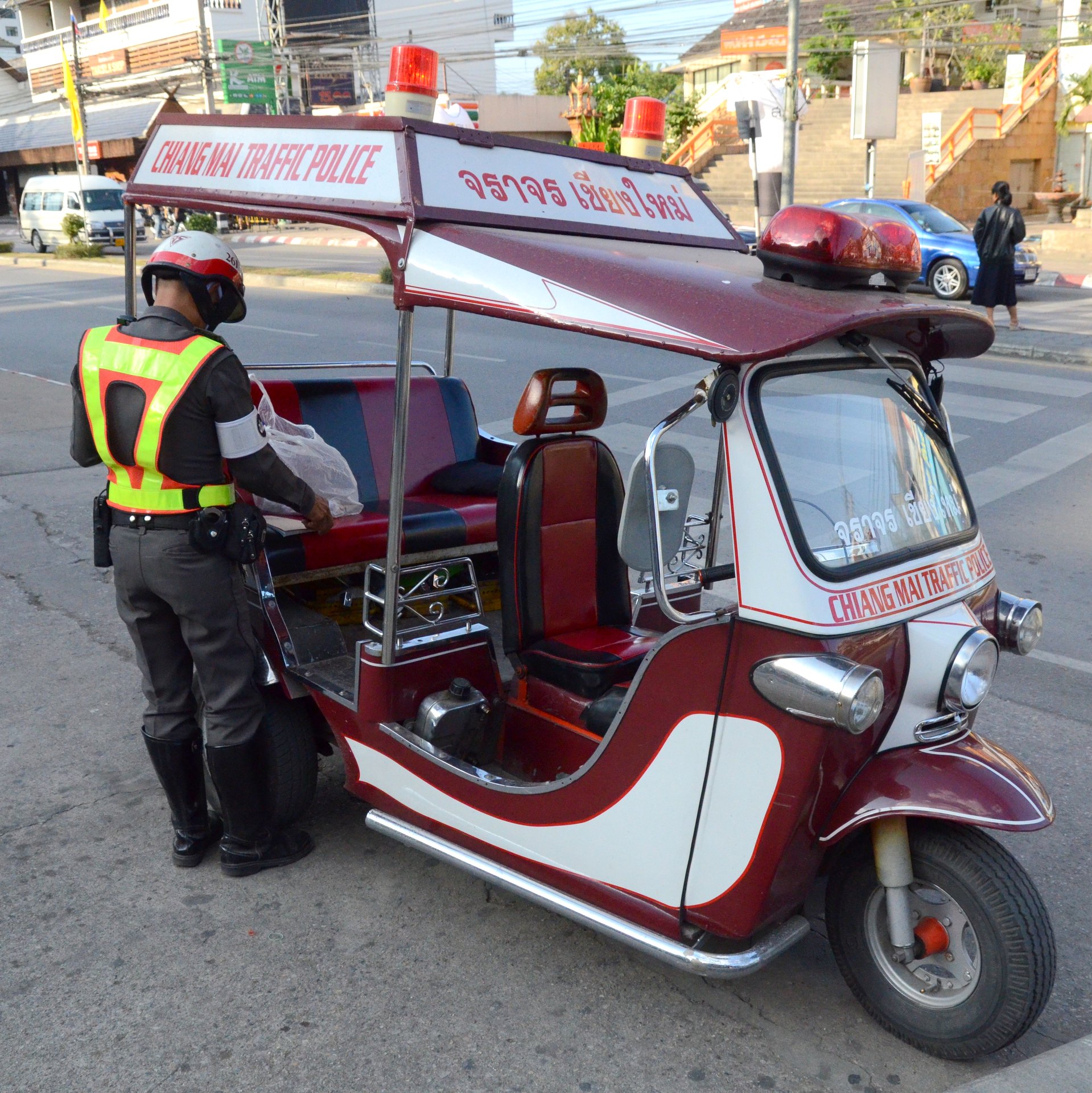
In Chiang Mai, taxis (and sometimes police cars) look like this.
Add in the freedom of going wherever the heck we wanted at the drop of a hat, and you have a bargain at twice the price. Though I must say Thai traffic patterns leave something to be desired: it definitely got a little hairy from time to time, especially when there were a lot of people on the road. And I don't imagine it was good for me to be sucking down all those exhaust fumes for the better part of a week.

But despite all these drawbacks, by the end of the trip we'd become quite attached to our little bike. I've always threatened to buy a motorbike here in Japan . . .

Tuesday, May 8, 2012

Angkor Day 3: Ta Nei, Ta Keo, and Chau Say Tevoda

This is part of a series of posts on our March 2012 trip to Cambodia. You can see some previous posts here, here, here, and here.


Our third day at Angkor was also our most ambitious: after visiting three temples in the morning, we hit another three temples in the afternoon. As with each of our Angkor excursions, our agenda was determined by geography rather than chronology, so the day included examples from a variety of time periods in a variety of architectural styles.


Ta Nei


Ta Nei is a 12th-century temple built during the reign of Jayavarman VII. Ta Nei is among the least-visited sites in the Angkor complex: a small ruin tucked away deep in the forest, tricky to get to and extremely difficult to find. These are, of course, the temple's main attractions.


Yet another enormous termite mound blocking a gallery. Our guide compared termites to ancient Angkor: whenever  the king dies, they pick up and build a whole new city somewhere else nearby. Hence the profusion of termite mounds, old temples, and termite mounds within old temples.

In case you couldn't tell, I can't get enough of these ruined towers!

Action sequence in 3 . . . 2 . . . 1 . . .

. . . go!


This lintel used to depict Buddha and his devotees. (Remember, Jayavarman VII was the Buddhist king who built the Bayon, with all the Brahma-Buddha-Jayavarman faces.) But Buddha's head was chopped off sometime after Jayavarman's death, when there was a big Hindu backlash against Buddhist imagery.

Aside from the many faces of Brahma-Buddha-Jayavarman VII, this is one of the only remaining Buddha carvings at Angkor. That's probably because it's so unusual: a somewhat non-canonical depiction of Buddha's escape from his controlling father's palace, during which Buddha steals silently away by galloping on the upraised hands of angels.


Ta Keo


Despite the similarity in their names, Ta Keo is pretty much the opposite of Ta Nei: much older, much larger, much more open, and in much better shape. Probably built sometime around 1000 AD, Ta Keo is a classic temple mountain - likely the first, in fact, to be built mostly of sandstone.
 Ta Keo also has some of the steepest steps.


Overall, the charms of Ta Keo are more about architecture than interior decoration. In other words, the view is stunning from both the bottom and the top, but a lot of the carvings are in pretty poor shape.


Forest, as far as the eye can see.


Chau Say Tevoda


Chau Say Tevoda was built in the mid-12th century, during the reign of Suryavarman II, the guy who built Angkor Wat itself. Like Angkor Wat, it exhibits a kind of classical simplicity, especially when compared to the more chaotic temples of Jayavarman VII.

Chau Say Tevoda only reopened to the public in 2009, after a lengthy restoration project led by the Chinese. This is awesome for two reasons: it still hasn't made it back into the rotation for most of the big tour groups, and the restored carvings are in fantastic shape.


All together now: Vishnu on Garuda.
Stay tuned for a final installment of temple touring, including the grandaddy of them all - the sprawling temple of Angkor Wat.

Monday, May 7, 2012

A Note to Our Readers


A few readers have voiced some confusion about our recent posts. Here are a couple quick clarifications for anyone wondering what's up.


1) If you receive updates by e-mail, you probably missed a few posts. E-mail wasn't working for a while, but it's working again now.


2) Also, if you receive updates by e-mail, you need to click through to the blog to view videos. We try to include links or reminders, but sometimes we forget!


3) Yes, we went to Thailand last week . . . but we're still catching up on posts from Cambodia!


4) Yes, we did spent most of our time in Cambodia schlepping through temples in the 100-degree heat. We never said we were wise.

Sunday, May 6, 2012

Back from Thailand

Flew in from Bangkok thus morning, and boy are my arms Thaired.

In other news: Philosophers and sages can only begin to fathom the depth of Nana's relief at the indefinite suspension of all puns on the word "Thai."

Sunday, April 29, 2012

Angkor Day 3: Prasat Kravan, Banteay Kdei, and Ta Prohm

This is part of a series of posts on our March 2012 trip to Cambodia. You can see some previous posts here, here, and here.


Full disclosure: after Kbal Spean, Banteay Srei, and Lake Tonle Sap, Nana and I were pretty exhausted. It turns out that touring all day in 100-degree heat takes a lot out of you. To make matters worse, we both finally succumbed to the stomach bug that had been going around school - a good dozen of our students were sick over the break. So in a rare triumph of common sense, we decided to rearrange our touring schedule so that we could spend the next day asleep.


The day after our day of rest, then, we set out for some highly efficient touring in the heart of the Angkor region: six temples in one day. This post covers the first three.


Prasat Kravan


Prasat Kravan, dedicated to Vishnu in 921, pre-dates most of the other Angkor temples. It shows: the temple has many features more typical of neighboring kingdom of Champa, in modern-day Vietnam. Most importantly, the interior of the main tower of Prasat Kravan has several detailed bas-reliefs carved directly into the red brick walls.

Vishnu.

Lakshmi with devotees.

Vishnu on Garuda.

Close-up of a Vishnu devotee. I don't think we got a good answer as to why there's a hole in his face. Usually, the holes were for applying stucco to rough brick carvings, but that doesn't seem to be the case here.

Prasat Kravan is also noteworthy for its linear arrangement of towers, though Nana was naturally more drawn to the lion guardian with a massive overbite.

Continuing our long-standing appreciation of stupid animals in need of dental work.
Banteay Kdei

Banteay Kdei was built during the reign of Jayavarman VII, sometime near the end of the 12th century. As a result, it shares many features with Angkor Thom and the Bayon, which are carefully calculated to symbolize harmony between the traditional Hinduism of the Khmer Empire and Jayavarman VII's own Buddhist faith.
The entrance, for instance, is capped with a face-tower, whose four faces simultaneously represent Brahma, the Four Noble Truths of Buddhism, and Jayavarman VII himself.

A close-up of a Garuda carving. Garuda, the mount of Vishnu, was important to both Hinduism and Buddhism.

The naga was also important to both faiths.

Banteay Kdei has been in nearly continuous use for centuries. Today, it's still the site of several small Buddhist altars, including this one tucked inside one of the eastern galleries.


Banteay Kdei still has traces of the reddish paint originally used to decorate the temples.
Here, below the two apsara.


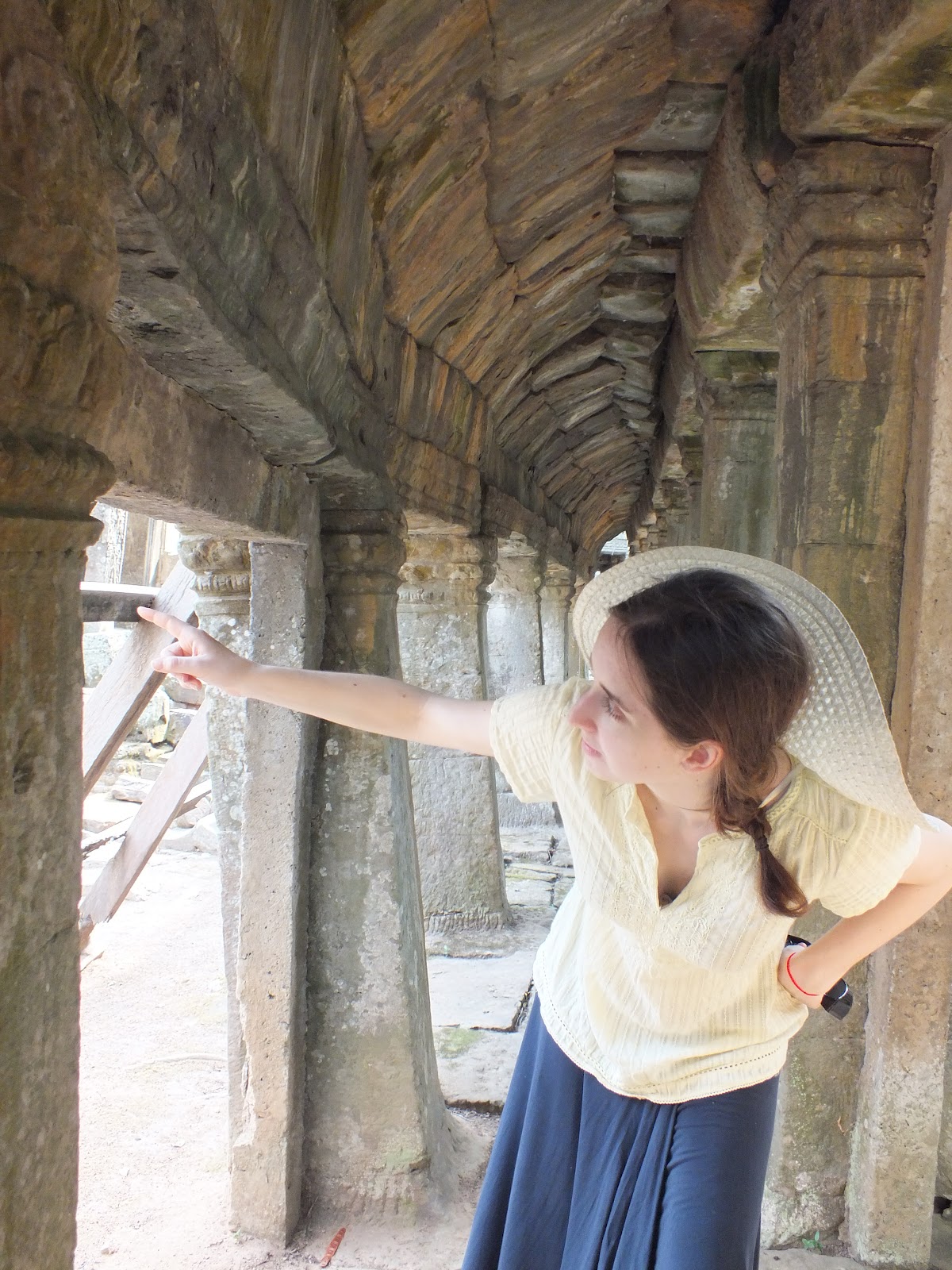
Banteay Kdei isn't in great shape, but that's part of its charm. This was the first of the truly ruined temples we visited - lots of fun to explore!

As far as I could tell, the tower was held together with luggage straps.


Two demons with bulging eyes.
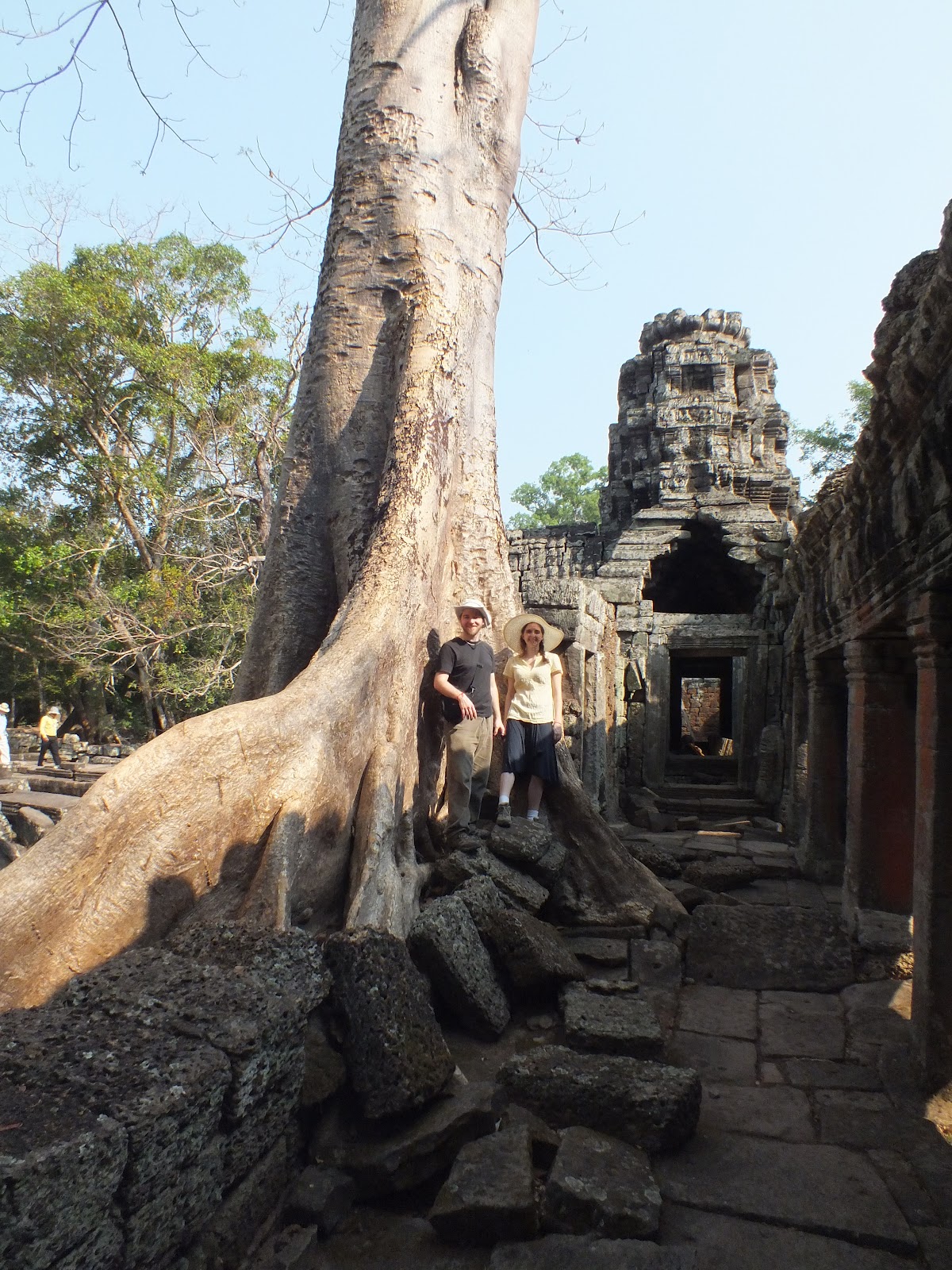
Banteay Kdei is also a good spot to catch one of the iconic sights of Angkor: huge silk cotton trees growing out of the ruined temple walls.


Overall, the feel of Bantey Kdei is very similar to that of Ta Prohm (below) - both are forest temples built in the jumbled and labyrinthine style of Jayavarman VII. But Bantey Kdei, being smaller and much less famous, has the advantage of being much quieter, though also significantly less impressive.

Ta Prohm

Ta Prohm is a sprawling temple monastery and university built in the late 12th century, during the reign of Jayavarman VII. Until recently, Ta Prohm had been left largely untouched since its "rediscovery" in the 20th century. The result is a very photogenic breed of chaos that makes Ta Prohm one of the most popular sites in the Angkor region.

If you ever see a photo of an enormous tree growing out of a temple wall, chances are it was taken at Ta Prohm.


Ta Prohm gets pretty crowded, which can take away some of the charm.

Luckily, our guide knew all the good little nooks and crannies away from the crowd, so we got to spend most of our visit feeling like we had the place to ourselves. That's really what Ta Prohm is about: playing explorer for a bit.


That's actually an enormous termite mound blocking the gallery. Ew.


Ta Prohm, unlike the other major Angkor sites, was originally dedicated as a Buddhist temple. As a result, it's one of the few temples built by Jayavarman VII to forego the careful blending of Hindu and Buddhism symbolism characteristic of his architectural style. Instead, Ta Prohm's symbolism is primarily Buddhist, but with touches drawn from the shared mythology of the two faiths.
The image of the hairy hermit appears to be universal.
However, the original Buddhist imagery of Ta Prohm has been largely destroyed. This is because Jayavarman VII's successors rejected his Buddhist faith and re-established Hinduism as the state religion, to the exclusion of all other faiths. Thus Ta Prohm is covered with empty niches that used to hold countless carvings of the Buddha.


Today, Ta Prohm is quickly changing, as an Indian-led team has taken a more aggressive approach to restoration. In fact, a huge portion of the middle precincts of the temple is off-limits to tourists as a major restoration project is underway. 


This is a departure from the established approach to conserving the temple, and reactions to the project have been mixed, especially among those who see some value in keeping at least one of the major Angkor temples in a semi-ruined state.