Wednesday, March 28, 2012

The Gods of Ancient Angkor

A few days ago, Nana introduced us to Khmer temple architecture. The hope was that we could link back to that post as needed so our readers wouldn't have to hear an explanation of what laterite is every time they visit the blog. This way, we could focus in later posts on what makes each individual temple unique.

Today, I'm going to attempt something similar: a brief introduction to Khmer religion, with a short roll call of the deities most commonly found in carvings around Angkor.

Religion


The religions of ancient Angkor were Indian in origin.

Officially, the Khmer Empire was a Hindu state with the god-king at its head, and the surviving state temples were almost all dedicated to Hindu deities and built in honor of the king himself or of his ancestors. Sometimes, there's evidence that the carvings of the gods in these temples are actually likenesses of the royals in whose honor the temple was constructed. Thus the temples often doubled as mausoleums for the royal family, whose ashes would be interred there.

In addition, the largest state temple complexes were also capital cities - their huge, empty precincts, many of which are now forested, would have been packed with wooden homes and buildings. This is another way of saying that there was no separation of church and state. Essentially, the church was the state, and the state was the church.

At the same time, we don't know much about the everyday religious practices of the Khmer people. What we do know is guesswork, based on fragmentary information and the assumption that locals worshipped at smaller, wooden temples and shrines that have not survived the intervening millennium. Most scholars suppose that the Khmer people practiced a blend of Hinduism, Buddhism, and local traditions of animism and ancestor worship.

At the very least, we know that Khmer Buddhism was strong enough to allow for Jayavarman VII, the major exception to official establishment of Hinduism in the Khmer Empire. Jayavarman VII is widely regarded as the greatest of the Khmer kings; he was also the last great king before the empire's decline. He was a Buddhist, and sought to establish Buddhism alongside traditional Hinduism as the new dual state religion of the empire.

The many temples built during the reign of Jayavarman VII symbolize in stone his efforts to reconcile the rival  faiths. His efforts failed in the short term - his successor, Jayavarman VIII, was a reactionary Hindu who destroyed the most overt Buddhist carvings of his predecessor's reign.

In the end, Jayavarman VII has had the last laugh: even the Hindu temples of Angkor have long since been taken over by Buddhists, and some have been in continuous use as sites of Buddhist worship for almost eight centuries.

The Gods


There are three main gods in Hinduism, collectively called the Trimurti. These three gods, like all Hindu gods, are actually just manifestations of a single, unfathomable God. Thus in practice, they tend to blend together, and in a sense a temple to one is a temple to all three.

Brahma


Brahma is the Hindu god of creation. He has four faces. He creates the new universe at the beginning of each cosmic era, but after that he doesn't really do anything. Hindus, practical folk that they are, don't spend much time on Brahma. There isn't a single temple at Angkor dedicated to Brahma's worship.

At Angkor, Brahma usually appears on a lotus blossom sprouting from the resting Vishnu's stomach, ready to launch the next cosmic cycle.
Sadly, after you've heard these stories a few dozen times,
they almost begin to make sense.
He's also represented by the face-towers strewn about in the reign of Jayavarman VII.

These towers have four faces, just like Brahma. However, they're not pure Brahma symbols: they also represent Jayavarman VII himself, watching over the four cardinal directions; and at the same time they represent the Buddha, which makes them the largest Buddha images to survive the reign of Jayavarman VIII.

Vishnu


Vishnu is the god of preservation or stasis. He's enshrined in a handful of temples around Angkor, including Angkor Wat. He is usually shown with four arms.

Often, he's riding Garuda, a god who's shaped like a man on top and like a bird on the bottom.
Chhaiy, our guide, was very careful to remind us
that Garuda does not fly.
Often, Garuda himself is used to stand in for Vishnu. It's common in Khmer art to use the god's vehicle as a symbol for the god. Garuda was also co-opted as a Buddhist symbol of intelligence and social cooperation.

Vishnu's wife is Lakshmi. She usually appears as a depiction of the real-life wife of the king (or king's father) honored by the temple.

Shiva


Shiva is the Hindu god of change or destruction. One of his primary aims was the destruction of evil. He was the most popular focus of worship in the surviving temples of Angkor. Accordingly, he shows up in many forms - too many to count, really, though the most common is definitely the linga or lingam, an abstract phallic statue on a pedestal that simultaneously represents Shiva, Vishnu, Brahma, and female fertility.

Here's a linga without the pedestal.
Nana's looking at a pedestal without its linga.
Shiva is often represented by his vehicle, the sacred bull Nandi.
Here's Nandi, about to wish a happy birthday to Nana's dad.
Shiva's wife is Sita. Like Lakshmi, Sita usually appears as a representation of the wife of whichever royal dude honored by the temple.

Indra

Indra is the Hindu god of the sky. He controls the weather. He rarely appears in person at Angkor - instead, he's represented by his steed, a three-headed elephant named Airavata (also Erawan).

Here's Indra riding Airavata.
Indra is one of the Hindu gods later co-opted by certain Buddhist traditions, in which he serves as the guardian of heaven. Jayavarman VII used Airavata frequently to symbolize harmony between the Hindu and Buddhist faiths.


Yama


Yama is the Hindu god of death and the dead. He's not common at Angkor, though you see him in a couple important bas relief carvings, and there was a statue of him on the misleadingly-named Terrace of the Leper King. (The statue there now is a replica.)

Naga


In the Cambodian tradition of Hinduism, the naga is a mythical serpent with a bunch of heads.

They're all over Angkor, and they're important both to Hinduism and to Buddhism. The naga is a key part of the Hindu creation story, as a huge naga is used by the angels and demons to churn an ocean of milk in an effort to achieve immortality (trust me, this is not the last you'll hear of this). According to some traditions, a naga also sheltered Buddha from rain and flood while he was meditating to achieve enlightenment.

Traditionally, the naga is the enemy of Garuda (above), but Jayavarman VII often depicted the two together, again symbolizing cooperation between the Hindu and Buddhist faiths.

Buddha


Buddha's not technically a deity, but we won't get into that here. At one time, during the reign of Jayavarman VII, there were probably as many Buddha images at Angkor as there were images of any Hindu god. Nowadays, most of them look like this:


Empty niche = former Buddha.
That's because Jayavarman VIII, who reverted to Hindiusm as the state religion, had most of the Buddha images at Angkor destroyed.

However, the famous face-towers of Jayavarman VII also represent Buddha.


It's likely Jayavarman VIII declined to destroy these images because they also represented Brahma and, at the same time, the personal power of the Khmer god-king. In fact, while all the obvious representations of Buddha have been destroyed, most of Jayavarman VII's layered Hindu-Buddhist imagery survives, giving many of the later Angkor temples a distinctly Buddhist vibe.

Note to family: Yes, we will be appearing in these photos, eventually. Stay tuned for some posts about our actual visits to the temples, once we've laid the groundwork with all this historical stuff.

Sunday, March 25, 2012

Putting the Red-Eye in Red-Eye

Nana and I got back to Fukuoka this morning via a bumpy four-hour red-eye flight from Siem Reap to Busan, South Korea. We promptly fell asleep for several hours, and hope to sleep fur about a bajillion more before we head back to work tomorrow.

Saturday, March 24, 2012

Cambodian Temple Architecture For Dummies

Cambodian temples tend to be built in concentric squares. You have a moat, an outer wall with a gate, then internal "galleries" (roofs with columns supporting them), and then temples in the middle.
Angkor Wat layout/floorplan, image from Wikimedia Commons
The isolated buildings on the left are referred to today as "libraries." I may or may not have get around to writing about them some other time. Everything between the outermost wall and the edge of the image is a moat, by which I mean an actual water-filled moat, not the dry ditch common in European castles:
Angkor Wat from the ground, our photo

Angkor Wat from the air; again, thanks to Wikimedia Commons. See why we opposed SOPA/PIPA?
Khmer architects dug moats not for defense against attackers, but from defense against nature. In Cambodia, you have a rainy season so intense that Tonle Sap lake, the largest freshwater lake in Asia, goes from ~2,700 square kilometers and 1 meter deep to ~16,000 square kilometers and 9 meters deep. That's 141,300 cubic meters of water, or basically adding Lake Ontario.

So the moats get dug up for two reasons: one, you move the land you dug up into the middle, to support the weight of the huge temple you're about to build. Otherwise, the thing will sink into the ground under its own weight. Second, the moat provides a drainage location for the huge amounts of rain which come down during the monsoon season. They may also have theological significance, as many temples reference the Hindu myth of the churning of the ocean of milk. I have this idea that the conversation between the kings and their designers went something like this:

Architect: Which story would you like for this first temple, sir?
King: ... What about that ocean of milk story? That's a good one.
Architect: Very good, Your Majesty. And the temple to honor your parents?
King: You know, I've always been fond of that churning story.
Architect: I see. Well, we can do that. Have you thought at all about your mausoleum temple?
King: (thoughtful pause) The ocean of milk?
Moat outside Bayon Temple, and creatively frustrated architect.
According to our guide, the reason that there are so many temples in Cambodia was that basically every time the king changed, the new king had to build a whole new capital with its own set of temples. So my guess is some of the early temples actually did sink, and that's how they learned what not to do. Reminds me of the point my high school US history teacher made, that by the time of the Constitutional Convention. the US delegates had written multiple constitutions for each of the original 13 states and also national constitutions. They were the world's leading experts on Constitution writing. Same with Khmer architects and swamp temples.

The concentric squares shown in the Angkor Wat drawing are like layers of a layer cake. As you go up, you go up to the surface only; There is no "inside" of the buildings (like an Egyptian pyramid). The middle section of the cake is just cake. If you hollowed out the supporting ground (the cake part) and filled it with, say, Mystical Treasure Traps, or Tunnels o' Death, the cake would collapse in on itself due to the weight of the cake topper. (So yes, Eddie Izzard fans, it does all boil down to cake or death.)


The inside of the temple structures are often different from the outside in one way, which is in materials. To go back to the cake-and-frosting metaphor (am I hungry or what?) the cake is a substance called "laterite," which is essentially clay which bakes into a hard stone brick when exposed to air. It is porous, cheap, and locally available, just what you want for the bulk of your construction. The porousness helps with the drainage, as water seeps into the stone, down through the building, and out into the moat.

Laterite (spongy-looking rock to the right of the door)
Laterite used as interior, visible behind sandstone

But laterite, like cake, has no nice surface. Imagine making frosting roses out of cake itself - it would crumble. (Many older, smaller temples were just made out of brick, which has the same advantages of laterite but is better for smaller buildings. It has the same disadvantage of being very difficult to carve).
Which did not stop them from trying.
So detailed carvings had to be made out of something different different. Early on, that choice was stucco, which was plastered over the brick or laterite and then carved:
Lolei Temple
Stucco, brick, and Justin.
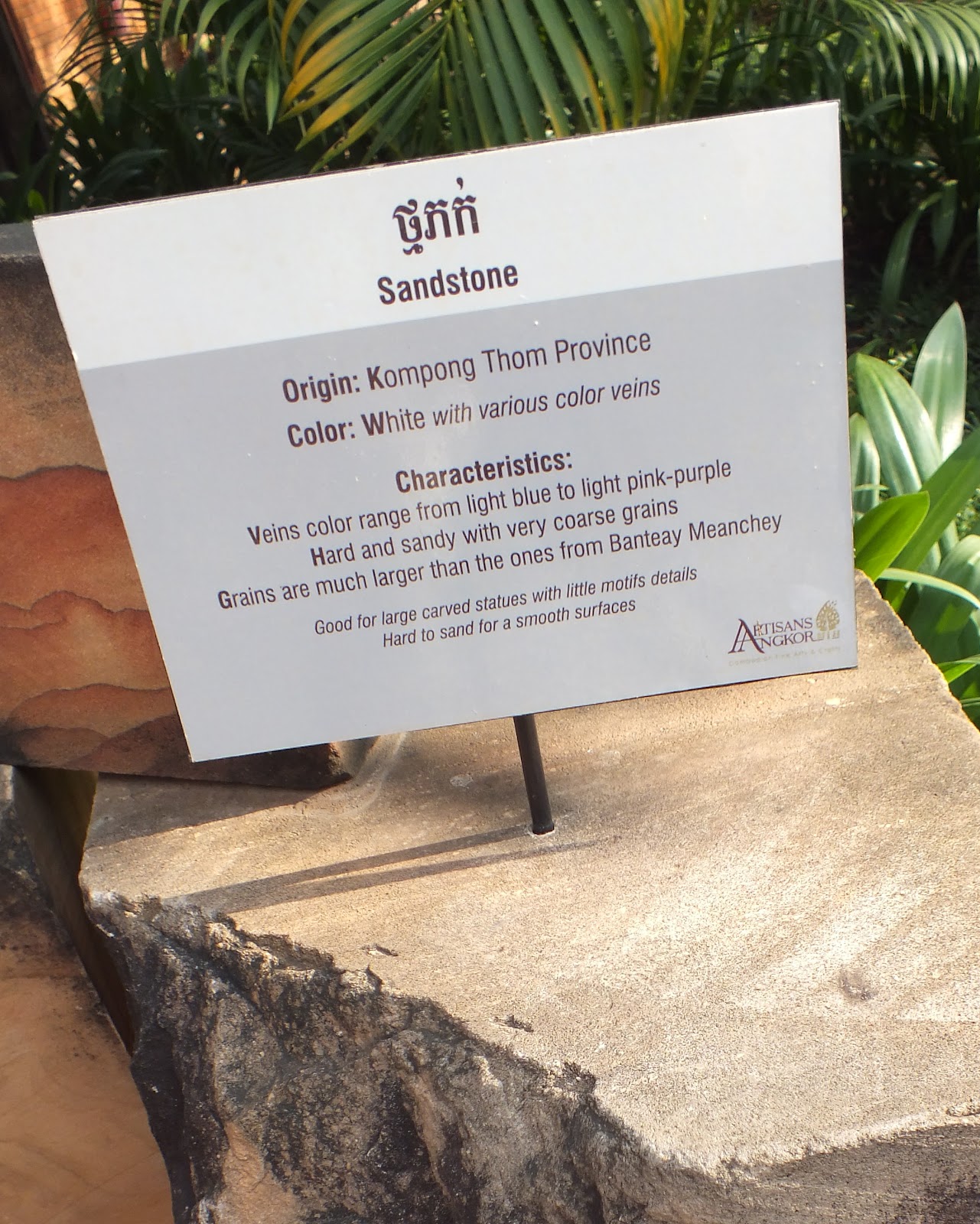
Later, sandstone came into use. Sandstone comes in many beautiful natural colors:


Which can be used to decorative effect:

It is also comes from very far away, and is very heavy. Chhaiy told us that the most popular method was to ship it on bamboo rafts in the rainy season, but it could also be loaded and moved via elephant.

There is one final danger with sandstone: the carving may be so precise and detailed that it seems real.

 
One of these photos is not of sandstone. Can you tell which?

Wednesday, March 21, 2012

Puttering around Siem Reap: Institute for Khmer Traditional Textiles

Poor Justin has either caught whatever I had in Fukuoka, or has started from scratch with something indigenous.

If we had read our Cambodian fortunes, we would have seen this coming.
Fortunately, we had set up our schedule to have some days off, and we moved one of them to today to allow him to rest. There are two bad things about Justin being sick. The first is that Justin is sick, and that sucks. The second is that without somebody paying attention, this is what I eat for lunch:

Fried bananas and vanilla ice cream. Indescribably good.
We've loved our hotel here (the Bunwin Boutique Hotel), not in the least because it has its own tuk-tuks (little carts pulled by motor scooters) and they provide you with a cell phone so you can call the hotel to be picked up or dropped off anywhere you like for free. We took motorcycle taxis around the Philippines but it always feels awkward, because I hate worrying about the price and haggling and wondering if I'm actually being taken where I want to go. Without the Bunwin tuk-tuks, I probably would have sat around the hotel all day. I'm not that confident going around by myself - I'm still not entirely convinced I'm an adult who should be let out on her own, and I'm always shocked when school trips come around and I'm the chaperone. So it was kind of a big deal for me to strike out on my own without Justin.

I went to the Institute for Khmer Traditional Textiles here in Siem Reap. The institute, like many Cambodian buildings, is a second-story only built up on stilts. The ground floor is really just a shadowed portico. That's where the workshop is; upstairs is a shop. There isn't a tour guide or anything, but you can read about the process and they have a DVD in English and Japanese.

The mission of IKTT is to preserve and grow the knowledge of Khmer textiles, which was nearly wiped out in the Cambodian Civil War and subsequent genocide. Permit me a history teacher detour for a moment (and my genuine apologies for the fact that this topic deserves more detail). Cambodia was part of the French colony of Indochina before World War II. Japan took over Cambodia during the war and put the monarch, Norodom Sihanouk, back on the throne. The king held on until 1970, when he was deposed by a military coup. To make matters worse, the US was bombing Cambodia as part of the Vietnam War. Within Cambodia, civil war broke out between rightist forces and the Communist Khmer Rouge, which took power in 1975. The Khmer Rouge and its infamous leader Pol Pot immediately set about trying to make everybody miss the good old days of civil war and bombing by instituting what is now called the Cambodian Genocide.

I am not going to be able to do the subject justice in this post, but the basics are as follows. Approximately 1 out of 5 Cambodians (somewhere in the area of 1.7 million) died in the Genocide (the notorious Cambodian Killing Fields are Cambodia's second most visited attraction, after Angkor Wat). You can see this impact statistically on the population pyramids of Cambodia - watch for the devastated red birth cohort of the 1975-9 period.  Main motivating factors appear to have been Communist ideology (targeting urbanites, religious people, intellectuals, etc) and nationalism (targeting ethnic minorities). For more information, I suggest the Yale Cambodian Genocide Program web site.

Vietnam invaded and occupied Cambodia in 1979. Eventually, under the UN, Cambodia negotiated its way to elections. To return to textiles, UNESCO brought a Japanese silk expert named Kikuo Morimoto to Cambodia to find out what, if anything, had survived of the traditional Khmer textile industry. The answer was not much. The Khmer Rouge had destroyed silk-weaving equipment and forbidden the teaching of techniques. Famine and displacement had devastated the trees and other natural infrastructure. Morimoto was able to identify a few very senior senior citizens. He began building on this knowledge, supporting apprenticeships by younger women and, a few years ago, buying land outside of Siem Reap for a village and farm complex to sustain silkworms and the plants which provide natural dyes. Today, IKTT employs nearly 500 Cambodians at various stages of the silk production process, and maintains good fair trade standards. Mothers are allowed to bring their children to the workshop - I saw a lot of kids running around or napping in hammocks while their mothers spun silk.

Here you can see the raw silk. Cocoons on the left, finished silk on top, and on the bottom, the raw gold silk which has not yet had the protein outer layer stripped off. It feels crunchy, like horsehair, while the ivory-colored finished silk is smooth as... yeah. You know.

Top: Dyed yellow from a plant called Prohut; bottom: dyed brownish pink via coconut

Red and purple come from the nests of the Lac insect


The grand product of IKTT is Cambodian ikat. Instead of these single-color threads, ikat involves dying a white thread multiple times to create a pattern on the thread itself. Basically, the threads are tied with bits of banana leaf, which cover up parts of the thread and keep them white. You dye in a certain order, retying banana leaf as necessary, until the thread is colored in such a way that it will produce a pattern upon weaving. The complexity and mathematics of this are mind-boggling.


White silk with banana ties
Multicolored threads being woven on a loom
 As you might guess, the products in the upstairs shop are amazing but priced to reflect this process. An ikat scarf is in the US $50+ range, while some exquisite wall hangings are priced upwards of $500. You can find cheaper items in monochrome or in handkerchief size.

So do I recommend a visit to IKTT? For two types of people: people who like to know about hand-production of textiles, and people who would like to own spectacular examples of hand-produced textiles. Since neither of these is Justin, it's just as well I went without him.

Please wish Justin a speedy recovery, as we have more temples we hope to see tomorrow!

Tuesday, March 20, 2012

Sunrise at Angkor Wat

Justin and I got up early this morning to go to Angkor Wat to watch the sun rise over the temples. Cambodia time is two hours behind Japan, so getting up at 4:30 AM (6:30 AM Japan time) wasn't exactly a dream, but for one of the great sights in UNESCO World Heritage, it was totally worth it.

We decided to go with a guide here, and it was definitely the right decision. Our guide Chheiy (I feel bad that I'm probably spelling it wrong; it's pronounced "Chai") picked us up at the hotel with a van at 5 AM and we drove out to the temple complex. Angkor Wat has five towers: imagine a square, with a tower in the center, and another tower on each of the four corners. From the front, it looks like there are only three towers. This is the view shown on the Cambodian flag. (Cambodia, for trivia buffs, is the only county to feature a building on its national flag).

Angkor Wat
However, there is a spot from the moat around Angkor where you can force perspective such that you see all five of the towers. This is where we went with our guide. Cambodians are enterprising, and local merchants had set down mats right along the waterline and reserved them for people who bought drinks from them. I felt like getting cheap and staying where we were, but fortunately Justin decided that $5 was worth it. We ended up with a spectacular spot right on the water, where nobody could get in front of us and mess up our photographs of the reflections, which is great, when you take a look at what would have been between us and the water if we'd stayed where we were:

Pictured: Every tourist in Siem Reap
So here's a time-lapse of our morning experience. First, it was dark. (This is to be expected). The bright-ish dot right over the temple is a beautiful crescent moon. 


The sun started creeping up over the horizon between 5:30 and 6 AM.


This picture is dorky, but it is evidence that we were there.


It was a long wait for the full sunrise but sometimes I think that's good for you. Angkor Wat has been around for eight hundred years. It was probably appropriate for me to sit for an hour. Plus, we got to watch little frogs and bugs bumbling about. Who needs television?

If you look closely, you can see a dragonfly in the foreground.
And then it happened!
Wait for it.... (Hum Also Sprach Zarathustra if it helps)

bum.... Bummm.... BUMMMMMMMMM!!!!
On the main causeway, we were able to squeeze in a couple of pictures of the sunrise alignment. See, Angkor Wat was built so that the sun would come right up the side of that main temple on the spring equinox. And through a brilliant and complete lack of planning, Justin and I were here on the spring equinox. Look at that sun go!


I think it rests on the exact tip of the temple after it rises a bit more, but I only learned that when I came home now. Plus, photographing the sun was starting to burn out my eyeballs, so maybe it's just as well we didn't stay and end up like Galileo.

Sunrise over Angkor Wat temple... that's one more thing off the bucket list!

Monday, March 19, 2012

Happy Birthday from Siem Reap!

Today was my (Nana's) dad's birthday. Since I couldn't be there to celebrate, I thought I'd send a little message from Cambodia. I'm standing at Lolei temple in the Rolous group, in front of a nice temple built by the king for his father. If you're keeping score, this was built around 892. If your offspring is the king, you get temples that last 1,200 years. If your offspring is the history teacher, you get a goofy photo.

But Cambodia, it turns out, is a pretty friendly place. Throughout the course of the day, I met many locals, all of whom wanted to join in wishing Dad the best. Here, for instance, are some well-wishes from a lion statue guarding Lolei.

Nandi, the bull, is the faithful steed of the Hindu god Shiva. He also wishes Dad happy birthday.


As do all nine heads of the snake god Naga.


This fish lives in a koi pond at the Butterfly Garden restaurant. He sends his best.


By afternoon, word of this auspicious day had spread to Angkor Thom, the big walled city. The causeway into the city is flanked by demons and gods tugging on the body of a snake, as part of the Hindu story in which they "churned the ocean of milk" to produce the "nectar of immortality." I'm not totally sure how that worked, but they were very busy, so it was awfully nice of them to take a moment out of churning to send birthday greetings.

Demons

Gods.
That's some nice churnin' there, boys.

Angkor Thom is famous as the home of dozens of towers of four-faced statues, which could represent the four faces of the Hindu god Brahma, or also the Four Noble Truths of Buddhist thinking. The king who constructed it was playing it safe and not taking sides, theologically. When we took this picture, a neighboring tour guide nodded thoughtfully and said, "This is a happy smiling statue for your father's birthday. Your father will certainly have good fortune."

Both the Hindus and Buddhists could agree on Dad's birthday.
On the Terrace of the Gods, unfortunately, Indra, the King of the Gods, couldn't make it, but he had his three-headed elephant Erawan bring a note.


A dancing Apsara, or Hindu/Buddhist angel/nymph, gave a special performance for the occasion.


The king and his concubines appreciated the excuse to party.


And last but not least, the crab says hi.

So there you have it, Dad: a birthday widely celebrated. Hope it was a great one!

Sunday, March 18, 2012

Welcome to Siem Reap!

After a long day of travel capped with a breezy night-time tuk-tuk ride across town, Nana and I have arrived at our hotel in Siem Reap.

Bonus: a gecko in our room to keep us company at night! Go, little gecko! Eat every bug you see!

(PS: Didn't publish last night for some reason. Let's try again!)