On our third day in Cairns, Nana and I rented a car for a long drive through the Atherton Tablelands, a sprawling plateau in Queensland's Great Dividing Range. Atherton is an interesting region: through tropical in latitude, its elevation makes it relatively cool and dry. It's currently a hotbed of farming and ranching; in days past, its mineral deposits sparked several mining booms and the hardwood forests of the plateau's eastern slopes supported a substantial logging industry.
In fact, Atherton is pretty much the reason Cairns exists: Cairns was established at the mouth of the Trinity River to serve as a port for the area's fertile hinterland.
That's Cairns in the distance below.
The problem? The plateau rises a good 4000 feet straight up into the air to the west of the city. The only two roads up the hillside are at least thirty minutes of hairpin switchbacks. A bit hairy in the morning, downright harrowing at night.
If you clicked on that video, you'll have noticed that it was Nana behind the wheel. That's because, in my infinite wisdom, I left my US driver's license in Japan - and surprisingly the Australians are no better than I am at reading Japanese. Luckily for us, Nana handled the switchbacks with aplomb.
Our reward: an excellent day in Atherton.
The eastern front of the tableland is part of the Wet Tropics World Heritage Site, which includes almost 10,000 sq km of tropical rainforest.
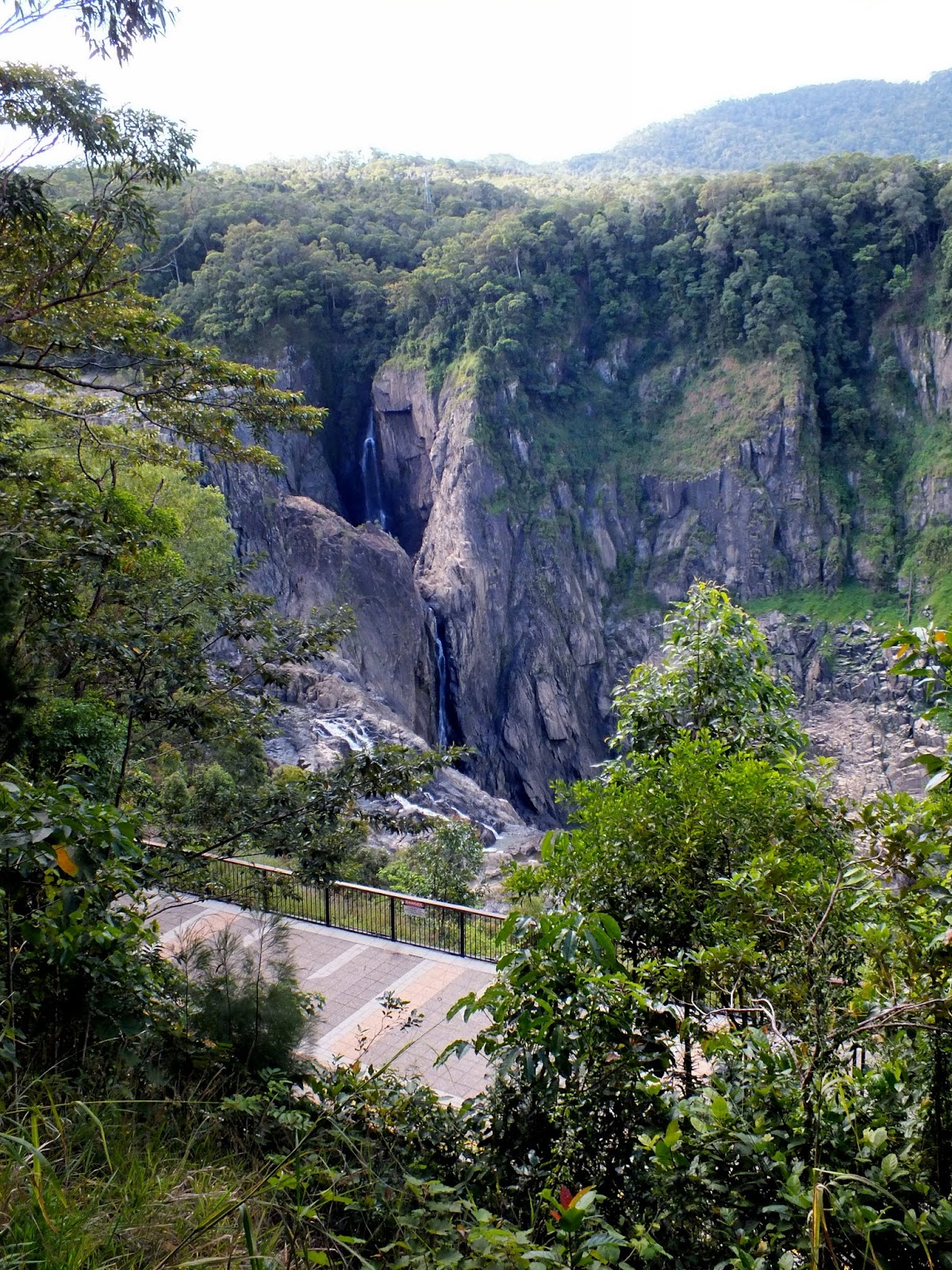
We stopped for a walk down the boardwalk that runs along Barron Gorge.
Barron Falls - a trickle in winter, but still a long way down.
Something you don't think about: rainforest often occurs in patches, usually in damp, sheltered gullies, surrounded by sparser upland areas. We imagine a bit of rainforest stretching on endlessly, like the Amazon basin, but sometimes a particular bit is only a couple hundred yards across.
Up into the tableland itself now.
Don't that look like cattle country?
A surprisingly noble post for the parking lot of Humpy Nut World.
Sunset. We paid the price with those switchbacks later!
Of course, we did a lot more in the Atherton Tablelands than drive and eat - we also met some of the local wildlife. More on that to come!
On our second day in sunny Australia, Nana and I struck out on a long walk to the Flecker Botanical Gardens in Cairns. This free public park is a great place to spot some beautiful Australian plant life. For this post, I'll let the photos speak largely for themselves. Enjoy!
En route along the Cairns foreshore.
The beach gives way to a big mud flat.
The Gondwanan Evolution Garden uses "living fossils" to simulate the evolutionary history of Australian plant life.
One expects to see dinosaurs.
(For a detailed explanation of why Australia's plant and animal life is so weird, check out this article by NOVA. Short version: before the arrival of Homo sapiens, Australia's biome was been isolated from the rest of the world for about 40 million years.)
Nana and I spent most of our time at Ayers Rock trying desperately to keep warm through a gauntlet of stunning sunrises and sunsets. But the morning of our last day in the Red Centre we took advantage of a free tour through the Ayers Rock Resort gardens, guided by the same folks in charge of the Aboriginal dance performances and cultural talks. The walk provided a great introduction to the plant life of the Australian Outback, which despite its arid climate is home to a wide variety of plants and animals.
Below are some shots of a few of the plants on the tour, with brief notes on any of the ones I remember learning about.
This bush produces berries colloquially known as "snot-gobblers."
As you can tell from Nana's expression, it's an appropriate name.
A famous desert plum - very important in the traditional diet of the local Aboriginal tribes.
This Jurassic-looking fern is, in fact, a living fossil, having survived for millions of years in central Australia's isolated ecosystem.
For whatever reason, most of the trees have whitish trunks. These are actually called "ghost trees."
You recognize these from every floral arrangement ever. Never knew they were native to the Outback!
This is the old man saltbush. Imagine spinach that tastes like potato chips.
Yum!
A desert rose.
A good shot of a ghost tree. You think of the Outback as being a desert, but most of it is more like very arid savannah - a mixture of sand and scrubby grasses, with sparse stands of trees in the low-lying areas.
This is a kind of aloe. Great for your skin, and also a source of water if you're stuck in the desert.
Even the leaves and needles have a silvery sheen.
This is a honeybush flower. The nectar tastes like, um, honey.
A quick glance out from the edge of the resort to more open country.