
Full disclosure: after Kbal Spean, Banteay Srei, and Lake Tonle Sap, Nana and I were pretty exhausted. It turns out that touring all day in 100-degree heat takes a lot out of you. To make matters worse, we both finally succumbed to the stomach bug that had been going around school - a good dozen of our students were sick over the break. So in a rare triumph of common sense, we decided to rearrange our touring schedule so that we could spend the next day asleep.
The day after our day of rest, then, we set out for some highly efficient touring in the heart of the Angkor region: six temples in one day. This post covers the first three.
Prasat Kravan

Prasat Kravan, dedicated to Vishnu in 921, pre-dates most of the other Angkor temples. It shows: the temple has many features more typical of neighboring kingdom of Champa, in modern-day Vietnam. Most importantly, the interior of the main tower of Prasat Kravan has several detailed bas-reliefs carved directly into the red brick walls.
 |
| Vishnu. |
 |
| Lakshmi with devotees. |
 |
| Vishnu on Garuda. |
 |
| Close-up of a Vishnu devotee. I don't think we got a good answer as to why there's a hole in his face. Usually, the holes were for applying stucco to rough brick carvings, but that doesn't seem to be the case here. |
Prasat Kravan is also noteworthy for its linear arrangement of towers, though Nana was naturally more drawn to the lion guardian with a massive overbite.
 |
| Continuing our long-standing appreciation of stupid animals in need of dental work. |
Banteay Kdei
Banteay Kdei was built during the reign of Jayavarman VII, sometime near the end of the 12th century. As a result, it shares many features with Angkor Thom and the Bayon, which are carefully calculated to symbolize harmony between the traditional Hinduism of the Khmer Empire and Jayavarman VII's own Buddhist faith.
 |
| The entrance, for instance, is capped with a face-tower, whose four faces simultaneously represent Brahma, the Four Noble Truths of Buddhism, and Jayavarman VII himself. |
 |
| A close-up of a Garuda carving. Garuda, the mount of Vishnu, was important to both Hinduism and Buddhism. |
 |
| The naga was also important to both faiths. |
Banteay Kdei has been in nearly continuous use for centuries. Today, it's still the site of several small Buddhist altars, including this one tucked inside one of the eastern galleries.


Banteay Kdei still has traces of the reddish paint originally used to decorate the temples.
 |
| Here, below the two apsara. |
 |
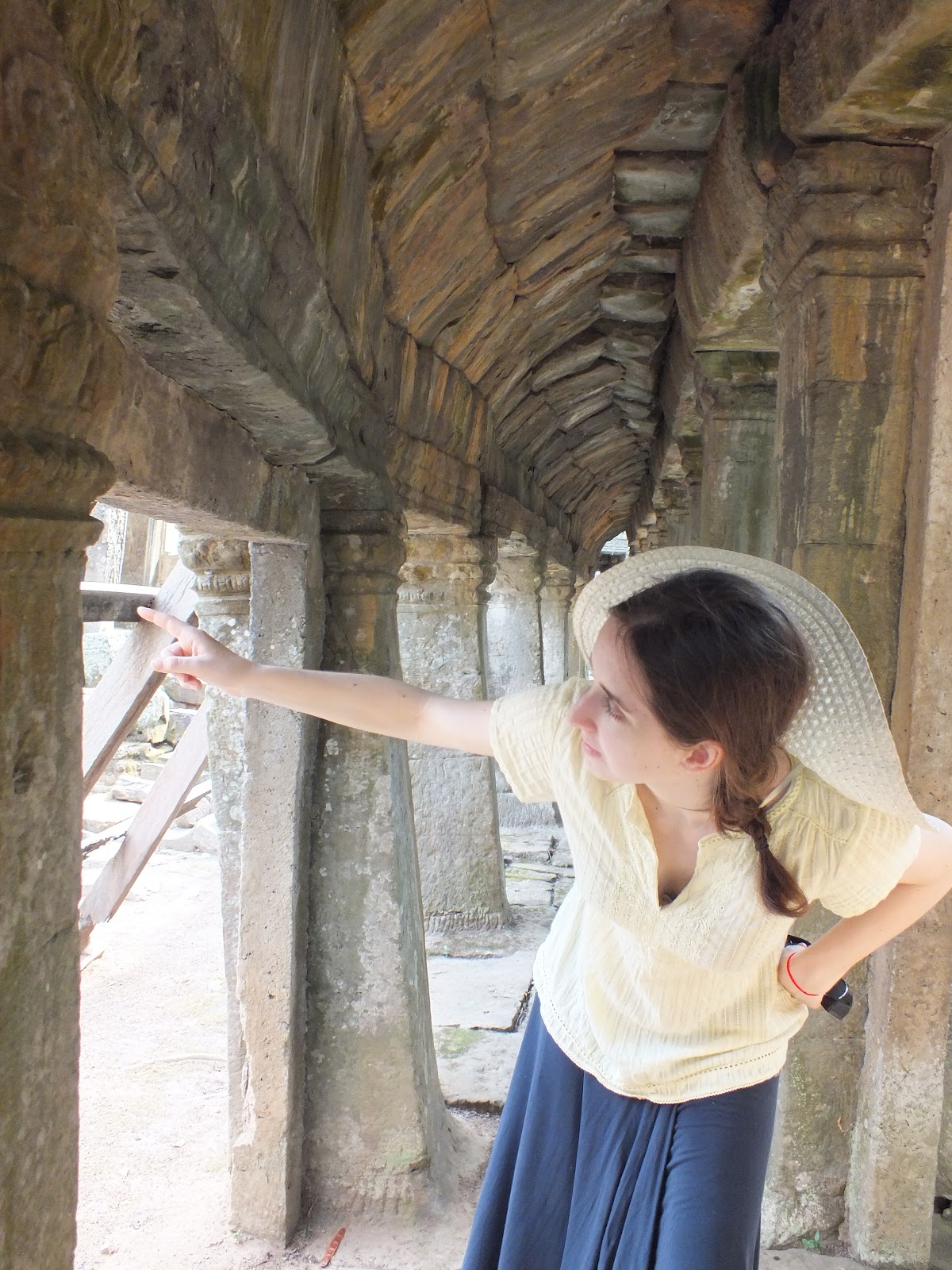
Banteay Kdei isn't in great shape, but that's part of its charm. This was the first of the truly ruined temples we visited - lots of fun to explore!

 |
| As far as I could tell, the tower was held together with luggage straps. |



 |
| Two demons with bulging eyes. |
Banteay Kdei is also a good spot to catch one of the iconic sights of Angkor: huge silk cotton trees growing out of the ruined temple walls.
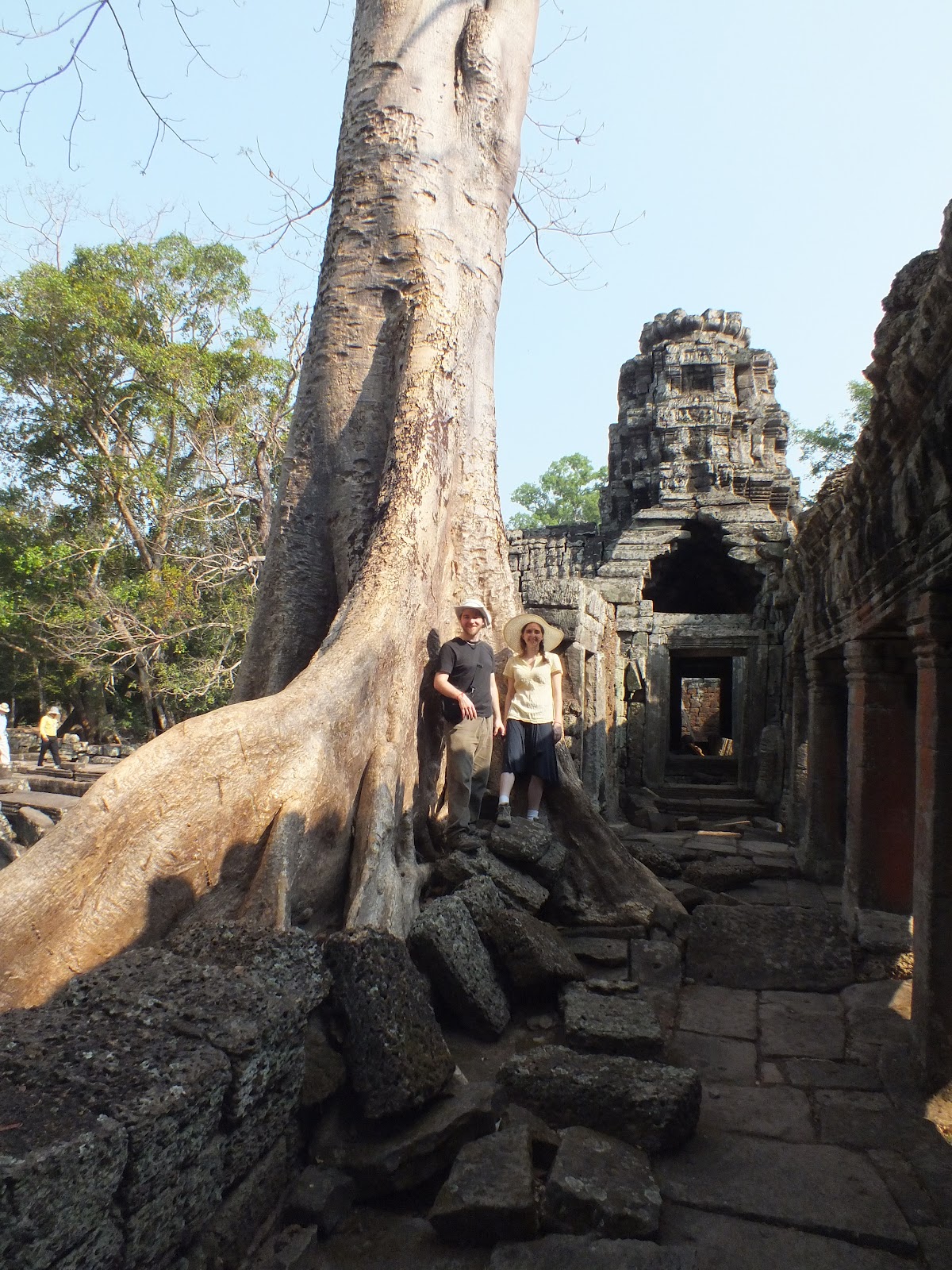


Overall, the feel of Bantey Kdei is very similar to that of Ta Prohm (below) - both are forest temples built in the jumbled and labyrinthine style of Jayavarman VII. But Bantey Kdei, being smaller and much less famous, has the advantage of being much quieter, though also significantly less impressive.
Ta Prohm
Ta Prohm is a sprawling temple monastery and university built in the late 12th century, during the reign of Jayavarman VII. Until recently, Ta Prohm had been left largely untouched since its "rediscovery" in the 20th century. The result is a very photogenic breed of chaos that makes Ta Prohm one of the most popular sites in the Angkor region.
If you ever see a photo of an enormous tree growing out of a temple wall, chances are it was taken at Ta Prohm.


Ta Prohm gets pretty crowded, which can take away some of the charm.

Luckily, our guide knew all the good little nooks and crannies away from the crowd, so we got to spend most of our visit feeling like we had the place to ourselves. That's really what Ta Prohm is about: playing explorer for a bit.


 |
| That's actually an enormous termite mound blocking the gallery. Ew. |


Ta Prohm, unlike the other major Angkor sites, was originally dedicated as a Buddhist temple. As a result, it's one of the few temples built by Jayavarman VII to forego the careful blending of Hindu and Buddhism symbolism characteristic of his architectural style. Instead, Ta Prohm's symbolism is primarily Buddhist, but with touches drawn from the shared mythology of the two faiths.
 |
| The image of the hairy hermit appears to be universal. |
However, the original Buddhist imagery of Ta Prohm has been largely destroyed. This is because Jayavarman VII's successors rejected his Buddhist faith and re-established Hinduism as the state religion, to the exclusion of all other faiths. Thus Ta Prohm is covered with empty niches that used to hold countless carvings of the Buddha.


Today, Ta Prohm is quickly changing, as an Indian-led team has taken a more aggressive approach to restoration. In fact, a huge portion of the middle precincts of the temple is off-limits to tourists as a major restoration project is underway.


This is a departure from the established approach to conserving the temple, and reactions to the project have been mixed, especially among those who see some value in keeping at least one of the major Angkor temples in a semi-ruined state.


